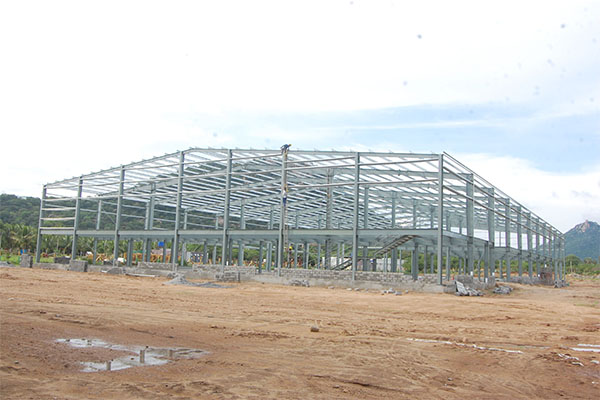



How Long Does Steel Building Construction Take?

Introduction

One of the first questions any client asks when planning a steel building project is: how long will this take? It is the right question – because your construction timeline affects your lease negotiations, your equipment procurement schedule, your staffing plans, and ultimately the date your business becomes operational.

The good news is that steel building construction is not only faster than conventional alternatives – it is also significantly more predictable. When you work with an experienced contractor, you get a realistic programme upfront, not a vague estimate that quietly extends itself week by week.

Lee Builders has been delivering steel building projects across India since 1995 – from compact industrial units to large-scale railway infrastructure for clients including Southern Railways. In this guide, we break down the construction timeline phase by phase, by building type, and by the factors that can speed things up or add time to your project.

Table of Contents

Why Steel Buildings Are Faster to Build

Before getting into the specific numbers, it is worth understanding why steel construction is faster than RCC – because that understanding shapes how you plan your entire project.

The Parallel Construction Advantage

With conventional RCC construction, every structural phase is sequential. You pour the columns, wait for them to cure, pour the beams, wait again, pour the slab, wait again. Each curing cycle adds weeks to the programme regardless of how many workers are on site.

With steel PEB construction, the most time-consuming phase – fabrication of the structural components runs simultaneously with site preparation and foundation works. While the foundation is being excavated, reinforced, and poured, the steel columns, rafters, and purlins are being cut, drilled, painted, and loaded for delivery at the factory.

By the time the foundation has cured and the site is ready for erection, the steel is already waiting. There is no gap between phases erection begins immediately.

Additional Speed Factors

  • No curing time on-site: bolted steel connections are complete the moment they are tightened no waiting required
  • Minimal wet trades: no formwork, no plastering, no concrete pours to schedule around the weather
  • Smaller, skilled erection crew: a well-organised steel erection team works faster and with fewer dependencies than a large general labour force
  • Lower weather sensitivity: steel erection can continue through light rain; RCC concrete pours cannot
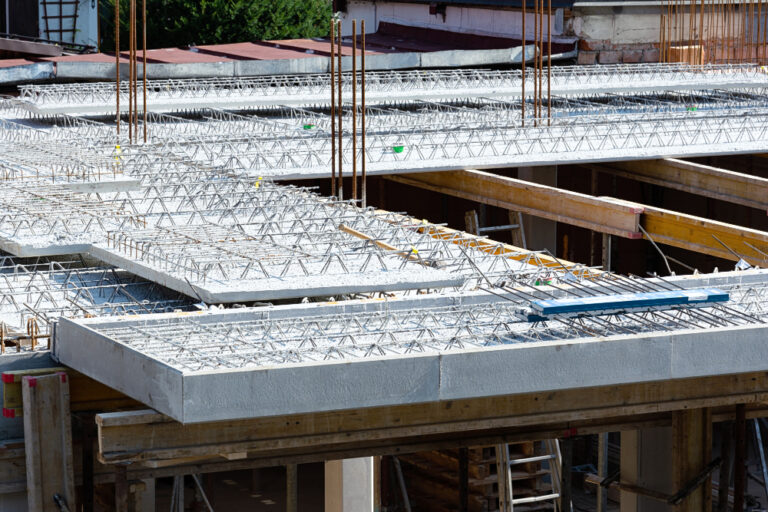
cost of pre-engineered building

The 6 Phases of Steel Building Construction

Phase 1 Brief and Requirements Weeks 1–2
  • Define span, height, use, location, load requirements, and required accessories
  • Site survey and soil investigation if not already completed
  • Initial concept review and budget-level estimate
  • Confirm project go-ahead and appoint contractor
Phase 2 Engineering and Design Weeks 2–4
  • Structural analysis and member optimisation using specialist design software
  • Preparation of general arrangement drawings, shop drawings, and Bill of Quantities
  • Client review and approval of drawings before fabrication begins
  • Permit and planning applications submitted in parallel

This phase can overlap with foundation design to save time on the overall programme.

Phase 3 Foundation Works Weeks 3–7 · runs parallel to fabrication
  • Excavation for column bases and ground beams
  • Steel reinforcement placed and column anchor bolts set to precise positions
  • Concrete poured for pad footings and ground beams
  • Curing period: 21 to 28 days for adequate structural strength
  • Floor slab preparation and pour follows if included in scope

Poor soil conditions or high water table can extend this phase significantly.

Phase 4 Steel Fabrication Weeks 2–8 · runs parallel to foundation works
  • Starts immediately after drawing approval — simultaneous with foundation works
  • Steel sections cut to length, holes drilled, and connections fabricated to shop drawing dimensions
  • Welding of built-up sections carried out in controlled factory conditions
  • All components cleaned, primed, and finish-coated with specified protective system
  • Components numbered and labelled for logical on-site assembly sequence
  • Quality checks carried out at each stage of fabrication

Standard spans up to 30 m: typically 4–6 weeks. Larger or complex structures: allow 6–10 weeks.

Phase 5 On-Site Erection Weeks 7–12
  • Steel components delivered to site and off-loaded in erection sequence
  • Columns set on anchor bolts, plumbed, and temporarily braced
  • Primary rafters lifted and bolted to column tops using mobile crane
  • Bracing, eave struts, and secondary framing installed to stabilise primary structure
  • Purlins and girts fixed to complete the secondary structural framework

5,000 sq. ft. single-span warehouse: approximately 2–3 weeks. 30,000 sq. ft. multi-bay warehouse: approximately 4–6 weeks.

Phase 6 Cladding, Finishing, and Handover Weeks 10–16
  • Roof cladding panels and insulation fixed to purlins
  • Wall cladding panels fixed to girts, with openings formed for doors and windows
  • Factory-made doors, windows, ridge vents, gutters, and downpipes installed
  • Mezzanine floors, crane rail systems, or internal partitions fitted if in scope
  • Electrical and mechanical rough-in coordinated with client’s services contractor
  • Snagging inspection, defect resolution, and final handover documentation issued

Timeline by Building Type

The total project duration varies significantly depending on the type and scale of the structure. Use the reference table below as a planning guide — these are project-to-handover timelines assuming prompt client approvals and standard site conditions.
Building Type Typical Size Total Timeline
Small industrial unit / workshop Up to 500 sq. m. 8 – 12 weeks
Single-span PEB warehouse 1,000 – 3,000 sq. m. 10 – 14 weeks
Multi-bay logistics warehouse 3,000 – 10,000 sq. m. 14 – 20 weeks
Cold storage facility 500 – 3,000 sq. m. 12 – 18 weeks
Multistorey steel building Varies by floors 20 – 36 weeks
Large industrial / railway shed 10,000+ sq. m. 24 – 40 weeks
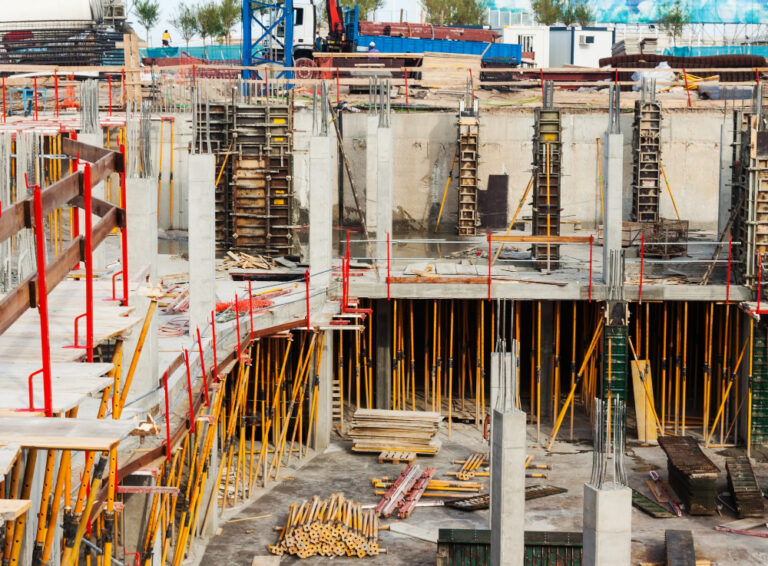
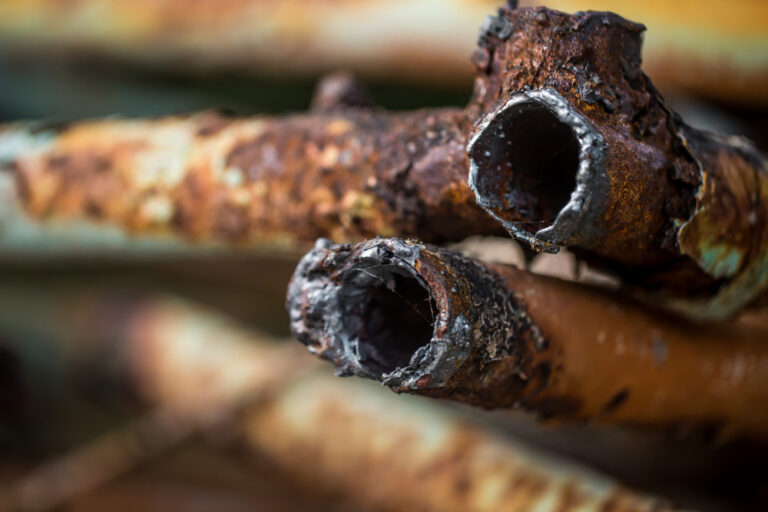
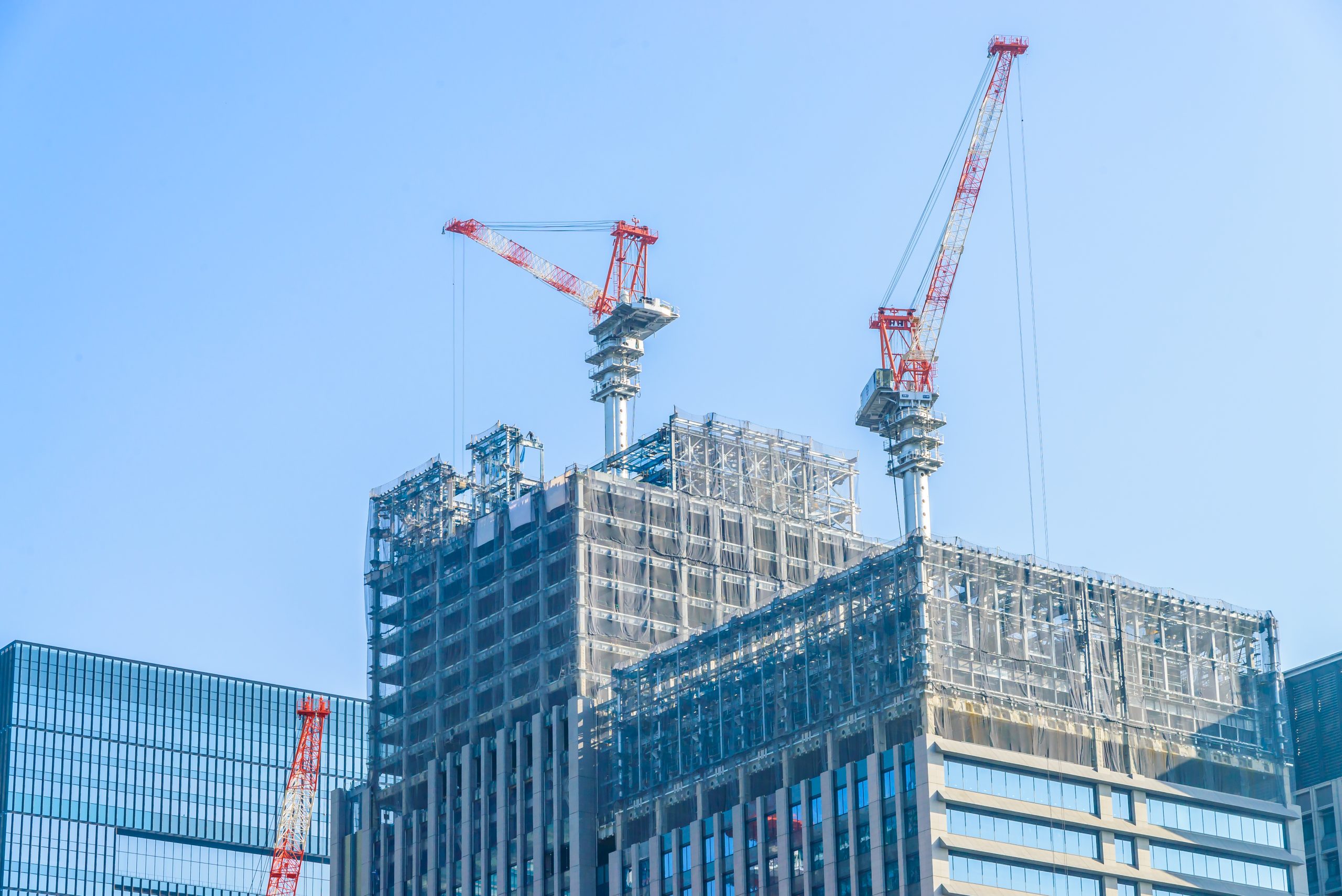
Construction building problems

What Affects the Construction Timeline?

Understanding the variables that influence your project timeline helps you plan realistically — and helps you ask the right questions of your contractor before you sign a contract.

Factors That Speed Things Up

Factors That Add Time

Standard span and height dimensions — reduces engineering complexity and fabrication time

Non-standard or complex structural geometry — additional engineering and fabrication effort

Good site access for cranes and heavy delivery vehicles

Poor soil conditions — weak, waterlogged, or variable soil requires deeper foundations or piling

Prompt client approval of drawings at each stage

Delayed client approvals — fabrication cannot begin until drawings are formally approved

Clean, level site with good bearing capacity

Multiple design changes after drawings are approved or fabrication has started

All specifications and accessories confirmed before design begins

Permit or planning approval delays — outside the contractor’s direct control

Experienced erection crew with appropriate crane equipment on site

Monsoon disruption — heavy rain affects erection scheduling and cladding installation

The Kerala Monsoon Factor

Kerala receives some of India’s heaviest annual rainfall, with the southwest monsoon running from June through September and the northeast monsoon bringing additional rainfall from October through November. Both periods can disrupt on-site construction activities — particularly erection and cladding installation, which are most affected by high winds and continuous heavy rain.

Experienced contractors plan around this. Foundation works are typically scheduled before the monsoon season begins. Structural erection and cladding are targeted for the post-monsoon window where possible, or planned in segments with weather holds built into the programme. Lee Builders factors Kerala’s seasonal weather patterns into every project programme from the outset.

Steel vs. Concrete - Timeline Comparison

For clients weighing up construction methods, the timeline difference between steel and concrete is often the deciding factor. Here is the comparison in plain terms:

Phase

Steel Building

RCC Building

Design and engineering

2 – 4 weeks

3 – 6 weeks

Foundation works

2 – 4 weeks

3 – 6 weeks

Structural works

3 – 6 weeks

12 – 24 weeks

Cladding and finishing

2 – 4 weeks

4 – 8 weeks

Typical total

10 – 16 weeks

22 – 44 weeks

The structural works phase is where the gap opens up decisively. A steel frame goes up in weeks; an RCC structure works through sequential curing cycles that cannot be accelerated regardless of resources applied. The difference between 10 weeks and 44 weeks represents three to six months of operating revenue, lease cost, and delayed business activity.

For a full analysis of the differences between steel and concrete warehouse construction — covering cost, durability, design flexibility, and sustainability — see our detailed comparison guide: Steel vs. Concrete Warehouse Construction: Which Is Better for Your Business?

How to Plan Your Project Around the Timeline

The most common timeline problems in construction projects are not caused by contractors working slowly — they are caused by clients and contractors not aligning on the critical path before work begins. Here is how to approach your planning to avoid them.

Work Backwards from Your Deadline

  1. Confirm your operational deadline: the date you need the building functional and ready for use
  2. Subtract handover and finishing time: typically 2 to 4 weeks
  3. Subtract erection time: based on your building type from the table in Section 3
  4. That gives you the latest date erection can start — which is also when the foundation must be complete
  5. Subtract fabrication and foundation lead times: 4 to 8 weeks depending on complexity
  6. Subtract design and approval time: 2 to 4 weeks
  7. Add a contingency buffer: 2 to 4 weeks for unexpected delays
  8. That is the date you need to initiate the project with your contractor


Submit Permit Applications Early

Planning and building permit applications run in parallel with design and fabrication — but processing times vary by local authority and are entirely outside your contractor’s control. In some Kerala panchayats and municipal areas, processing can take 4 to 8 weeks or longer. Submit applications as early as possible and never assume approval will arrive on a specific date.

Lock Down Specifications Before Fabrication Begins

Every design change after shop drawings are approved costs time and money. Before approving drawings, confirm: building dimensions, eave height, roof pitch, door and window positions and sizes, cladding specification, insulation requirements, crane system loads if any, and any special structural features. Changes after fabrication has started can add 2 to 6 weeks to the programme.

Lee Builders — Delivering on Time, Every Time

A timeline is only as reliable as the contractor behind it. Here is what Lee Builders brings to every steel building project:
What we bring What it means for your timeline
29+ years of steel construction project delivery Realistic programming from experience — not optimistic guesswork
In-house fabrication capability No third-party fabricator lead time uncertainty or communication gaps
Dedicated project management from brief to handover One point of contact tracking every milestone and flagging issues early
Proven track record with time-sensitive projects Including railway infrastructure for Southern Railways with fixed commissioning dates
Kerala-based with strong regional supply chain Established relationships with crane operators, suppliers, and local subcontractors
Written programme issued before work begins Milestone dates, critical path, and change management process agreed upfront
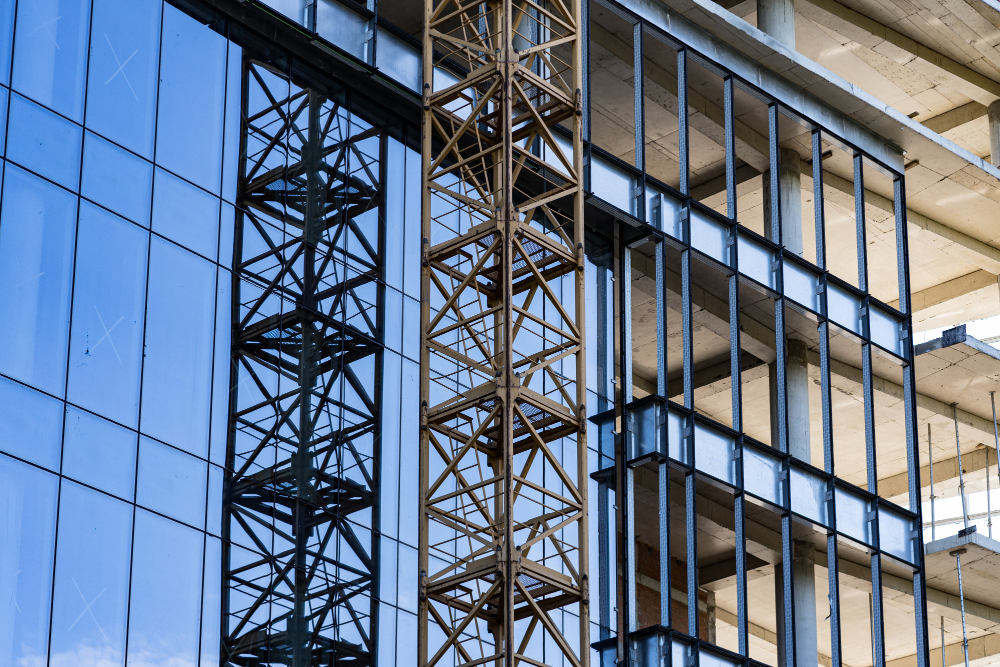
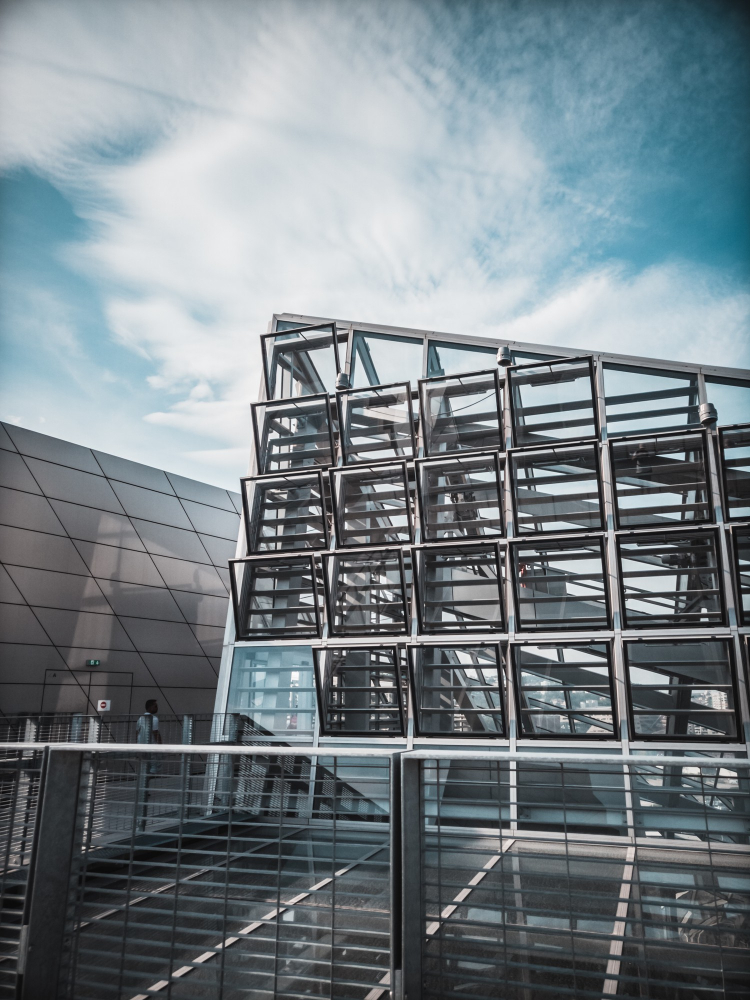
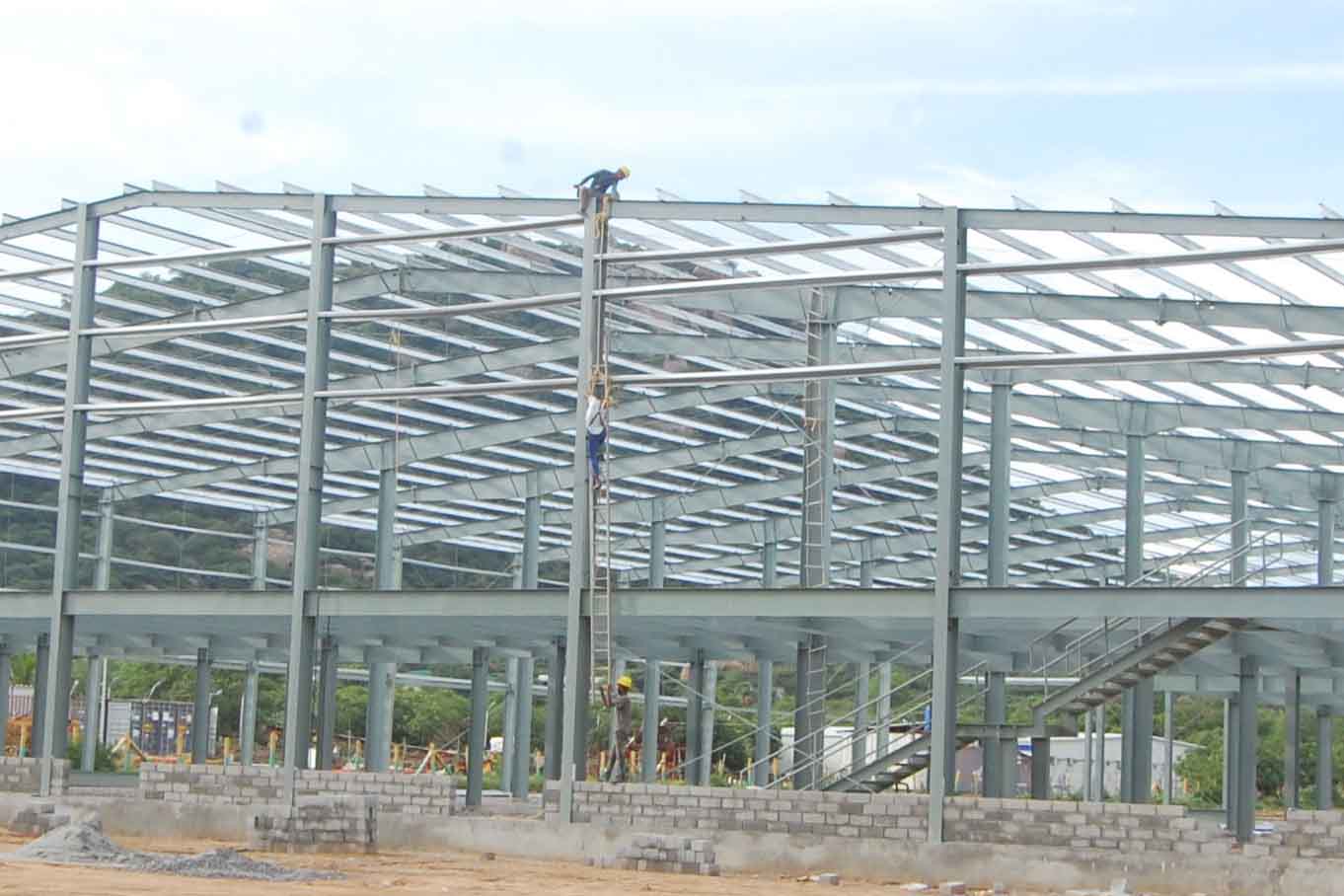
a structure of pre-engineered building

Conclusion

Steel building construction in India typically takes 10 to 16 weeks for a standard warehouse — less than half the time of an equivalent RCC structure. The timeline is predictable and manageable when properly planned, with the parallel fabrication and foundation phases providing the critical time advantage that makes steel the right choice for any business with a firm operational deadline.

The keys to hitting your timeline are straightforward: start early, lock down specifications before fabrication begins, submit permit applications in parallel, and work with a contractor who gives you a written programme upfront rather than promises managed on a handshake.

Lee Builders has been delivering steel construction projects on time across India since 1995. Our team has the in-house capability, the regional experience, and the project management discipline to get your building to handover — on schedule.

Steel vs Concrete Warehouse Construction

Introduction

You have a warehouse to build. You have a site, a brief, and a budget. And you have a decision in front of you that will affect your construction cost, your timeline, your operational efficiency, and your maintenance bills for the next 30 to 40 years: steel or concrete?

Both materials have been used to build warehouses successfully across India. Both can deliver a structurally sound, functional building. But for most industrial and logistics applications today, one option pulls significantly ahead in cost, speed, flexibility, and long-term value.

This guide from the team at Lee Builders steel construction specialists based in Perumbavoor, Kerala, with over 29 years of experience gives you an honest, objective comparison of both approaches. By the end, you will have a clear framework for making the right decision for your specific project.

What this guide covers

Understanding the Two Construction Methods

Before comparing them, it helps to understand exactly what each approach involves because the differences start at the very first stage of construction.

Steel Warehouse Construction (PEB / Structural Steel)

  • Primary structure: hot-rolled steel frames (columns and rafters) designed and fabricated off-site
  • Assembly method: bolted connections on-site minimal wet work, no formwork required
  • Building envelope: colour-coated or insulated metal cladding panels for roof and walls
  • Foundation: typically isolated pad footings or a combined footing lighter and shallower than RCC equivalents
  • Timeline advantage: fabrication runs in parallel with site preparation

Concrete Warehouse Construction (RCC)

  • Primary structure: reinforced cement concrete columns, beams, and slabs cast in-situ or using precast panels
  • Assembly method: formwork, pouring, curing sequential process that cannot run in parallel
  • Building envelope: block or brick masonry walls with plaster finish; concrete or metal roof
  • Foundation: heavier structure requires deeper pad footings, raft foundations, or pile foundations depending on soil conditions
  • Timeline: each structural phase must cure before the next begins

It is also worth noting that hybrid structures exist for example, a steel roof over concrete columns, or a steel superstructure on a concrete podium. These are used in specific situations but are outside the scope of this comparison, which focuses on the two dominant approaches for warehouse construction.

cost of pre-engineered building

Cost Comparison

Cost is the number-one question for any warehouse project. The honest answer is that steel and concrete need to be compared across three distinct cost layers not just the headline construction cost.

Layer 1: Construction Cost per Square Foot

Specification

Steel Warehouse

Concrete Warehouse

Basic industrial (standard span)

Rs. 1,500 – Rs. 2,000 / sq. ft.

Rs. 1,800 – Rs. 2,400 / sq. ft.

Mid-range commercial / logistics

Rs. 2,000 – Rs. 2,800 / sq. ft.

Rs. 2,400 – Rs. 3,200 / sq. ft.

High-spec / insulated

Rs. 2,800 – Rs. 3,500 / sq. ft.

Rs. 3,000 – Rs. 4,000+ / sq. ft.

At the construction stage, steel is typically 15 to 25 percent cheaper than an equivalent RCC structure. The reasons are straightforward: less on-site labour, minimal formwork, and factory-optimised steel sections that use only the material required by the engineering model.

Layer 2: Foundation Cost

Steel structures are significantly lighter than their concrete equivalents. A typical PEB warehouse exerts far lower column loads on the ground, which translates directly into smaller, shallower foundations. In good soil conditions this saves money; in poor or waterlogged soil common in parts of Kerala, it can make a substantial difference to the overall project budget.

RCC structures, by contrast, are heavy. They demand larger pad footings, raft foundations, or in weak soil conditions, a piled foundation system. These costs add up quickly, particularly for large-footprint warehouses.

Layer 3: Lifecycle Cost (Maintenance and Repair)

This is where the long-term picture comes into focus. Over a 30-year ownership period:

  • Steel cladding: periodic recoating every 10 to 15 years; structural steel itself is virtually maintenance-free if properly detailed and coated at installation
  • RCC structures: concrete carbonation, rebar corrosion, and spalling are common in India’s humid climate particularly in coastal Kerala; plaster cracks, seepage, and waterproofing failures require ongoing attention and expenditure

When all three cost layers are added together across the full ownership period, steel consistently delivers a lower total cost of ownership for warehouse applications in India.

steel vs concrete warehouse - construction timeline

Construction Timeline

For a business waiting to begin operations, every week of construction delay has a real cost, lease payments on a site that isn’t generating revenue, delayed product launches, or missed seasonal demand windows. The timeline comparison between steel and concrete warehouses is one of the starkest differences between the two approaches.

Phase

Steel Warehouse

Concrete Warehouse

Design and engineering

2 – 3 weeks

3 – 6 weeks

Foundation works

2 – 4 weeks

3 – 6 weeks

Structural erection

3 – 6 weeks

12 – 24 weeks

Cladding and finishing

2 – 3 weeks

4 – 8 weeks

Typical total duration

10 – 16 weeks

22 – 44 weeks

The decisive factor is that steel fabrication runs in parallel with site preparation and foundation work. While the foundation is being cast and cured, the steel components are being cut, drilled, and painted in the factory. The moment the foundation is ready, erection can begin immediately.

With RCC construction, each phase is sequential. The columns must be poured and cured before the beams can be cast. The beams must be complete before the slab can be poured. Each stage adds weeks of elapsed time regardless of how many workers are on-site.

steel vs concrete warehouse - durability

Structural Performance and Durability

The most common concern clients raise when considering steel warehouses is a straightforward one: is steel actually as strong as concrete? The answer backed by decades of engineering data and thousands of completed structures across India is yes, and in several key respects, stronger.

Strength and Load-Bearing Capacity

Modern structural steel has a far higher strength-to-weight ratio than reinforced concrete. A steel frame can carry equivalent loads using a fraction of the material mass. PEB frames are engineered to IS 800 (Code of Practice for General Construction in Steel) and IS 875 (Code of Practice for Design Loads) the same regulatory framework that governs RCC design in India.

Steel warehouses routinely handle heavy uniformly distributed floor loads, overhead crane systems, mezzanine floors, and roof-mounted equipment all without any structural compromise.

Wind and Seismic Performance

Steel has a structural property that RCC lacks: ductility. In an extreme wind event or seismic load, a steel frame deforms before it fails absorbing energy and giving time for occupants to evacuate. RCC, by contrast, is brittle under extreme loads unless very carefully designed and detailed with additional reinforcement.

Kerala falls within Wind Zone III under IS 875. Lee Builders designs every structure to be fully compliant with the applicable wind zone and seismic zone requirements for the project location.

Durability in Indian Conditions

Both steel and concrete warehouses can achieve service lives of 40 to 50 years or more when properly designed and maintained. The vulnerabilities are different:

  • Steel’s primary vulnerability: corrosion effectively managed through hot-dip galvanising of connections, factory-applied protective coatings, and good architectural detailing that prevents water ponding or trapping
  • RCC’s primary vulnerabilities: concrete carbonation and chloride ingress leading to rebar corrosion, spalling, and structural degradation particularly aggressive in Kerala’s coastal, high-humidity environment
steel vs concrete warehouse India

Design Flexibility and Scalability

Clear Span – Unobstructed Floor Space

This is perhaps the single most important structural difference for warehouse operators. A steel PEB frame can achieve clear spans of 60, 70, 80, or even 90 metres and beyond with no internal columns whatsoever. The entire floor area is available for racking, forklift movement, production lines, or bulk storage.

An RCC structure, by contrast, requires columns at intervals of 6 to 9 metres depending on the slab design. In a 60-metre wide warehouse, that means a grid of internal columns that disrupts racking layouts, limits vehicle turning circles, and reduces usable storage volume. For logistics and warehousing operations, this is a significant operational disadvantage.

Building Height

Modern logistics warehouses require clear internal heights of 10 to 18 metres to accommodate high-bay racking systems. Achieving these heights in RCC is expensive formwork costs, concrete volumes, and the engineering complexity of tall slender columns all add cost. Steel achieves tall eave heights naturally and economically, with no additional structural complexity.

Future Expansion

This is where the long-term business case for steel becomes undeniable. A PEB warehouse can be extended along its length by adding bays simply bolting new frames onto the existing end frame. The building can be widened, raised in height, or fitted with additional mezzanine levels. Crane systems can be added to existing frames if specified at the design stage.

Expanding an RCC warehouse typically requires demolition of structural walls or columns, redesign of the foundation system, and significant disruption to ongoing operations. In most cases it is more economical to build a new structure than to expand an existing RCC one.

Sustainability and Environmental Impact

Sustainability is an increasingly important consideration for businesses with ESG reporting requirements, green building certifications, or simply a commitment to responsible construction practices.

Steel

  • 100% recyclable at end of life, steel retains full material value when the building is eventually demolished or reconfigured
  • Factory fabrication generates minimal on-site waste,  components are cut to precise dimensions in the factory
  • Lighter structure requires less concrete and excavation for foundations lower embodied carbon in the substructure
  • Insulation systems (glasswool, rockwool, polyurethane sandwich panels) deliver high thermal performance, reducing operational energy consumption
  • Can contribute to GRIHA and LEED green building credits

Concrete

  • Cement production is among the highest sources of embodied carbon in the construction industry globally
  • Demolition waste is largely non-recyclable and ends up in landfill
  • Heavier structure demands more material in foundations higher total embodied carbon


For businesses that need to report on their construction footprint or are targeting green building certification, steel is the significantly more sustainable option.

a picture of a building being constrcuted by concrete

When Concrete Is Still the Right Choice

Lee Builders is a steel construction specialist but we also believe in giving clients an honest assessment. There are specific situations where conventional RCC construction remains the more appropriate choice:

  • Multi-storey residential construction: RCC remains the standard for apartment buildings, housing, and mixed-use residential structures where the floor plate, partition layout, and acoustic requirements suit cast-in-situ or precast concrete
  • Structures requiring masonry facades: where local planning requirements or architectural briefs specify a stone, brick, or masonry appearance that is difficult to achieve with metal cladding
  • Very small structures: for buildings under 200 square metres, the economics of a full PEB system with its engineering, fabrication, and logistics overhead do not scale down efficiently
  • Extremely remote locations: where steel transport is impractical due to poor road access but local aggregate and labour are readily available
  • Very heavy floor loading throughout: for industrial processes involving extremely heavy machinery, presses, or forging equipment that benefit from thick RCC slabs across the entire floor plate

If your project falls into one of these categories, Lee Builders will tell you, and refer you to the right solution. Our goal is to recommend the best outcome for your project, not simply to sell steel.

The Verdict - Which Should You Choose?

Here is the decision framework in plain terms:

Choose Steel if…

Choose Concrete if…

✅  Your project is a warehouse, factory, logistics hub, or cold storage

✅  The project is residential or mixed-use with significant living spaces

✅  Speed of construction is a priority

✅  Local planning requires a masonry or stone facade appearance

✅  You want maximum unobstructed floor space for racking or operations

✅  The structure requires extremely heavy RCC floor slabs throughout

✅  You may need to expand or reconfigure the building in the future

✅  The site is remote with very limited steel transport access

✅  Long-term cost efficiency and sustainability matter to your business


✅  You are building in a coastal or high-humidity environment like Kerala


For the overwhelming majority of warehouse, industrial, logistics, and commercial building projects in India, steel is the better choice. It is faster, more economical, more flexible, and more sustainable. The technology is mature, the engineering codes are well-established, and the track record speaks for itself.

a structure of pre-engineered building

Why Lee Builders for Your Steel Warehouse Project?

When you commission a warehouse from Lee Builders, you get a single point of accountability across every phase from structural design through factory fabrication to on-site erection and handover.

What we bringWhat it means for your project
29+ years of steel construction experienceProven expertise across every scale of warehouse project
End-to-end delivery under one roofDesign, fabrication, erection no coordination gaps between contractors
In-house metal fabrication capabilityFull quality control at every stage of production
Diverse project portfolioWarehouses, cold storage, multistorey buildings, railway infrastructure
Government and institutional track recordCompleted projects for Southern Railways
Kerala-based, pan-India project capabilityLocal knowledge, national reach, competitive logistics
Transparent, itemised pricingNo hidden costs you know exactly what you are paying for
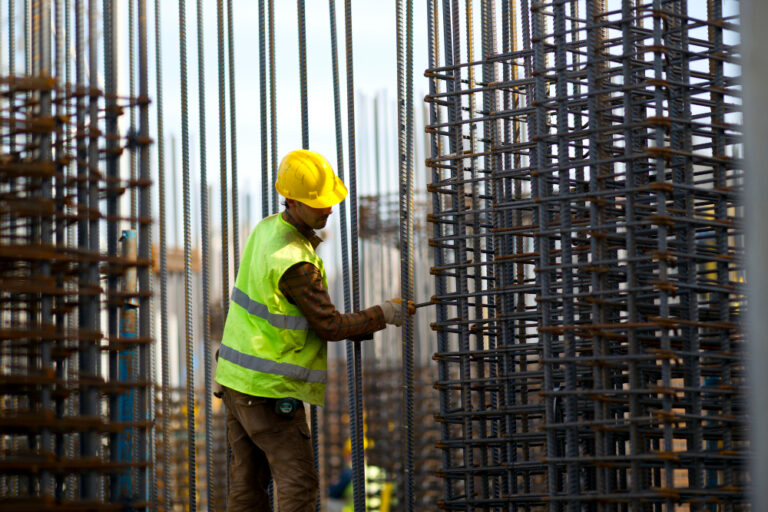
Working hard building man construction worker

Conclusion

For warehouse construction in India, steel wins on cost, speed, flexibility, and sustainability in the vast majority of scenarios. It delivers lower construction costs, a lighter foundation requirement, a faster build programme, column-free floor space, easy future expansion, and significantly lower lifecycle maintenance expenditure.

Concrete has its place primarily in residential construction and specific situations where RCC is clearly the right engineering or planning choice. But for industrial, logistics, and commercial warehouse projects, the case for steel is overwhelming.

Lee Builders has been building steel structures across India since 1995. Our team has the experience, the in-house capability, and the track record to deliver your warehouse project on time, on budget, and built to last.

What Is a Pre-Engineered Building?

Introduction

You need a large commercial space, a warehouse, factory, or industrial facility. You need it built fast, within budget, and strong enough to last decades. If you’ve started researching your options, you’ve likely come across the term ‘Pre-Engineered Building’ or PEB. But what exactly is it? And is it right for your project?

Pre-engineered buildings have transformed the construction landscape in India over the past two decades. They offer a smarter, faster, and more cost-efficient alternative to conventional construction and for the right applications, they are simply unmatched.

In this guide, the team at Lee Builders, steel construction specialists based in Perumbavoor, Kerala, with over 29 years of experience breaks down everything you need to know about PEBs before you break ground.

What you'll learn in this article

What Exactly Is a Pre-Engineered Building?

A pre-engineered building (PEB) is a steel structure that is designed, engineered, and fabricated at a factory then transported to the site and assembled by a skilled erection team. Unlike conventional construction, where materials are sourced, cut, and assembled entirely on-site, a PEB arrives as a precision-manufactured kit of parts, ready to be bolted together.

The term ‘pre-engineered’ refers to the fact that the structural system is fully engineered in advance using specialised software that optimises every component for load, span, and local conditions before a single piece of steel is cut.

Key Components of a Pre-Engineered Building

A complete PEB system typically consists of:

  • Primary steel framing – the main structural skeleton (columns, rafters, and primary beams)
  • Secondary framing – purlins, girts, and eave struts that support the cladding
  • Roof and wall cladding panels – metal sheeting that forms the building envelope
  • Doors, windows, and ventilators – factory-fitted or site-installed accessories
  • Mezzanine floors, crane systems, and other accessories as required

Every component is designed to work together as an integrated system. This is what makes PEBs significantly more efficient than building a structure piece by piece.

a structure of pre-engineered building

How Does a Pre-Engineered Building Work?

Understanding the PEB process helps explain why it is faster and more efficient than conventional construction. Here is how it works from start to finish:

  • Step 1 – Requirement gathering
    • The process begins with a detailed brief  span, height, load requirements, intended use, site location, and climatic conditions. This information drives every subsequent design decision.
  • Step 2 – Engineering and design
    • Specialist software is used to model the structure and optimise each member for strength and efficiency. Detailed shop drawings and a Bill of Quantities are produced before fabrication begins.
  • Step 3 – Factory fabrication
    • Steel components are cut, drilled, welded, and coated with primer in a controlled factory environment. Quality checks are carried out at each stage. This phase runs parallel to site preparation saving weeks of time.
  • Step 4 – Delivery to site
    • Components are labelled, packed, and transported to the site along with an erection manual. Every piece is accounted for before delivery.
  • Step 5 – On-site erection
    • The structure is bolted together on-site by a trained erection crew. Most connections are bolted rather than welded, making the process faster, safer, and more consistent.
  • Step 6 – Finishing and handover
    • Cladding panels are fixed, doors and windows are installed, and any finishing works (gutters, downpipes, fascia) are completed. The building is ready for fit-out.
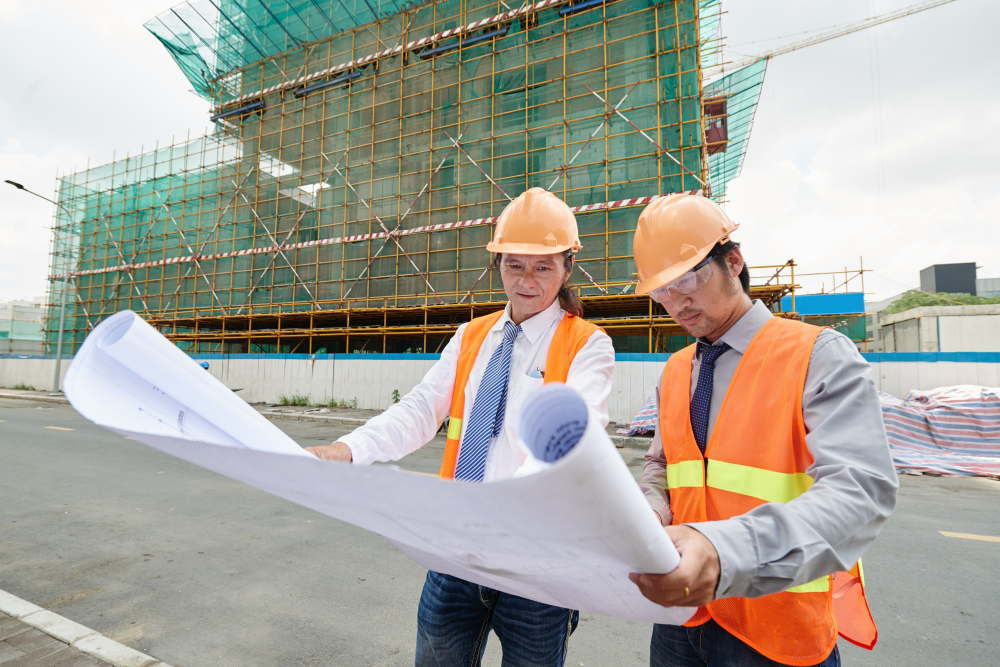
picture of 2 construction engineers looking at blueprint

What Are Pre-Engineered Buildings Used For?

One of the greatest strengths of PEB technology is its versatility. Pre-engineered steel buildings are used across a wide range of industries and applications in India:

  • Industrial Applications
    • Manufacturing plants and assembly units
    • Processing facilities and production halls
    • Automobile workshops and service centres
  • Logistics and Storage
    • Warehouses and distribution centres
    • Cold storage and temperature-controlled facilities
    • Bulk storage structures
  • Commercial Buildings
    • Hypermarkets and large retail showrooms
    • Exhibition halls and convention centres
    • Petrol station canopies and service forecourts
  • Infrastructure
    • Aircraft hangars and MRO facilities
    • Railway maintenance sheds and platform shelters
    • Metro and transit structures
  • Institutional
    • Sports halls, indoor stadiums, and gymnasiums
    • School and college assembly halls
    • Community centres and multipurpose buildings

PEB vs. Conventional Construction - Key Differences

The most common question clients ask is: how does PEB compare to traditional RCC (Reinforced Cement Concrete) construction? The table below provides a clear answer:

FactorPre-Engineered Building (PEB)Conventional (RCC) Construction
Construction time4-12 weeks (typical)6-18 months
Overall cost20-30% lower (typical)Higher – more labour and material
Design flexibilityHigh – custom spans and heightsModerate
Clear span (no columns)Up to 90 metres and beyondLimited without expensive beams
Future expansionEasy – bolt-on bays or extensionsDifficult – demolition often required
WeightLighter – lower foundation costHeavier – larger foundations needed
MaintenanceLow – galvanised or coated finishesModerate to high
SustainabilityRecyclable steel, minimal site wasteHigher material waste, non-recyclable
Best suited forIndustrial, commercial, logisticsResidential, small commercial


It is worth noting that conventional RCC construction still makes sense in certain scenarios, particularly for low-rise residential buildings, structures in high-seismic zones with specific design requirements, or projects where the building aesthetics require masonry facades. A good contractor will recommend the right system for your project rather than pushing a single solution.

Advantages of Pre-Engineered Buildings

Here is a closer look at the benefits that have made PEB the preferred construction method for industrial and commercial projects across India:

1. Faster Construction Timeline

Factory fabrication runs in parallel with site preparation. Once the foundation is ready, erection of a medium-sized PEB can be completed in as little as four weeks. For businesses, this means faster operations, earlier revenue generation, and lower project holding costs.

2. Significant Cost Savings

Reduced labour on-site, minimal material waste, optimised steel usage, and shorter construction timelines all contribute to cost savings that typically range from 20 to 30 percent compared to equivalent conventional structures.

3. Column-Free Clear Spans

PEBs can achieve clear spans of 90 metres or more without internal columns. For warehouses, factories, and exhibition halls, this is a decisive advantage — unobstructed floor space maximises operational efficiency.

4. Engineered Durability

Hot-rolled steel components with factory-applied protective coatings deliver long service life with minimal maintenance. PEBs are engineered to applicable IS codes for wind, snow, and seismic loads relevant to their location.

5. Easy Future Expansion

A PEB can be extended by adding bays to the length or width, or by adding mezzanine levels, without major structural disruption. This makes PEB the sensible choice for businesses planning to scale.

6. Sustainability

Steel is 100 percent recyclable. PEB construction generates significantly less waste on-site compared to conventional builds. For businesses with ESG commitments, this is an increasingly important factor.

7. Suited to India’s Climate

Proper insulation options, including fibreglass wool, polyurethane foam panels, and reflective foil systems, are available for PEB roof and wall assemblies. Buildings in Kerala and other high-rainfall, high-humidity zones can be fully weatherproofed to the required specification.

cost of pre-engineered building

How Much Does a Pre-Engineered Building Cost in India?

Cost is naturally one of the first questions clients ask. The honest answer is that there is no single number, PEB costs vary depending on several factors:

  • Building size – total floor area and footprint
  • Span and height – wider and taller buildings require heavier steel sections
  • Roof pitch and architectural features
  • Cladding specification – standard colour-coated, insulated sandwich panels, or specialised systems
  • Accessories – doors, windows, skylights, ventilators, crane systems
  • Site location and soil conditions – affects foundation design and transport costs
  • Local labour rates and erection complexity

Indicative Cost Range (India, 2024)

As a general indicative guide, PEB projects in India typically fall in the range of:

SpecificationApproximate Cost Range (per sq. ft.)
Basic industrial (single skin, standard span)Rs. 1,500 – Rs. 2,000
Mid-range commercial / logisticsRs. 2,000 – Rs. 2,800
Insulated / cold storage / high-specRs. 2,800 – Rs. 3,500+

Cost-Saving Tips

  1. Standardise dimensions where possible – non-standard spans and heights add engineering and fabrication cost.
  2. Plan for future expansion upfront – it is far cheaper to design expansion provisions now than to retrofit them later.
  3. Bundle multiple structures – if your project involves more than one building, package them together for better pricing.
  4. Choose the right cladding – over-specifying insulation on a non-temperature-sensitive building adds cost without benefit.

Is a Pre-Engineered Building Right for Your Project?

Run through this quick checklist. If you tick three or more boxes, PEB is very likely the right solution:

✅  You need a large clear span (20 metres or more) without internal columns

✅  Your timeline is a priority – you need the building operational as soon as possible

✅  Budget efficiency matters – you want to maximise value per rupee invested

✅  The structure is for industrial, commercial, logistics, or institutional use

✅  You may want to expand or modify the building in the future

✅  Sustainability and low maintenance are important considerations

If your project is primarily residential, requires a specific architectural masonry facade, or is below 300 square metres, a conventional approach may be more appropriate. Lee Builders is happy to assess your requirements and recommend the most suitable construction method – with no obligation.

Why Choose Lee Builders for Your PEB Project?

Lee Builders has been a trusted name in steel construction across India since 1995. Here is what that means for your project:

What we bringWhat it means for you
29+ years of steel construction experienceProven expertise across hundreds of projects
End-to-end delivery under one roofDesign, fabrication, and erection — no coordination gaps
Diverse project portfolioWarehouses, cold storage, multistorey buildings, railway infrastructure
Government and institutional track recordCompleted projects for Southern Railways
Kerala-based, pan-India capabilityLocal knowledge, national reach
In-house metal fabricationQuality control at every stage of production
pre-engineered building

Conclusion

Pre-engineered buildings represent one of the most significant advances in construction technology available to Indian businesses today. They are faster to build, more cost-effective, highly adaptable, and proven across every major industrial and commercial sector.

Whether you are planning a warehouse, factory, cold storage facility, or large commercial structure, PEB is worth serious consideration. The combination of engineering precision, factory quality, and rapid site erection delivers outcomes that conventional construction simply cannot match at the same cost or budget.

Lee Builders has been delivering steel construction excellence since 1995. Our team is ready to guide you from concept to completion.

Omkaranathan Indoor Stadium Kalpetta: Building a Landmark in Wayanad!

Introduction

Infrastructure development projects generally reflect many things. They reflect vision, perseverance, engineering skills, and people. The Omkaranathan Indoor Stadium in Kalpetta, Wayanad, is an infrastructure development project that reflects many things. It reflects vision, perseverance, engineering skills, and people.

Located in the heart of the Wayanad district in the hilly region of Kerala, the stadium has now emerged as one of the most important infrastructures in the region. What makes the Omkaranathan Indoor Stadium project even more interesting is the high degree of engineering that has been put into it.

Right from the beginning of the project, the responsibility of executing the construction work of the Omkaranathan Indoor Stadium was handed over to Lee Builders. It is interesting to note that despite the difficulties that were present during the execution of the project, the company has successfully completed the work within the stipulated time.

With an overall value of ₹38 crore, the Omkaranathan Indoor Stadium has now emerged as an important milestone in the infrastructure development sector in the state of Kerala.

A Vision for Modern Sports Infrastructure in Wayanad

The district of Wayanad has always been recognized for its beauty, mountains, and the high spirits of the people living there. But the development of such large infrastructure projects needs specific planning and construction skills.

The idea behind the construction of the Omkaranathan Indoor Stadium in Kalpetta was to build an indoor stadium that could accommodate indoor games, sports, and other activities. The idea was to develop a large indoor arena that could support various sporting activities and provide a safe environment for the sportspersons.

The construction of such an arena in the region of Wayanad was not only about the vision and idea behind the construction of the arena but also about the engineering skills that could adapt well to the geographic location of the region.

From the initial stages of the construction of the arena to the final stages, Lee Builders was at the center of the construction of the Omkaranathan Indoor Stadium.

Construction in Challenging Terrain

Wayanad’s terrain presents unique challenges for construction projects. Unlike urban construction environments where transportation and accessibility are easier, building large infrastructure in hilly regions requires careful logistical planning.

The Omkaranathan Indoor Stadium project faced similar challenges from the beginning.

The site was located in an area where access roads were narrow, making the transportation of construction materials a complex task. Moving heavy structural steel, construction equipment, and building materials required precise coordination and scheduling.

Each stage of the project required careful planning to ensure that materials reached the site safely and on time without disrupting the surrounding area.

In addition to logistical challenges, the region experienced landslide incidents and heavy rainfall during the construction period. These environmental conditions made construction work even more demanding, requiring additional safety precautions and adjustments in project scheduling.

Despite these challenges, the construction team continued to work steadily, ensuring that progress remained consistent throughout the project timeline.

Overcoming Logistics Challenges

The topography of Wayanad poses special difficulties for construction works. Unlike the usual construction sites found in cities, where transportation is not a problem, the topography of the region poses difficulties for the construction of large infrastructure projects.

The construction of the Omkaranathan Indoor Stadium was not an exception to the difficulties that can be expected in the region.

The construction site was located in an area where the roads leading to the site were narrow. This posed a great challenge for the transportation of materials to the construction site. The transportation of structural steel, equipment, and materials for the construction of the building was a complex activity.

Each step of the construction process was carefully planned to ensure that materials reached the construction site safely and on time, without disturbing the region.

Besides the difficulties presented by the topography of the region, the region experienced landslips and rainfall during the construction period. The environmental conditions posed an additional challenge to the construction process.

Despite the difficulties experienced during the construction of the Omkaranathan Indoor Stadium, the construction team worked steadily to ensure that the construction process was consistent with the expected timeline.

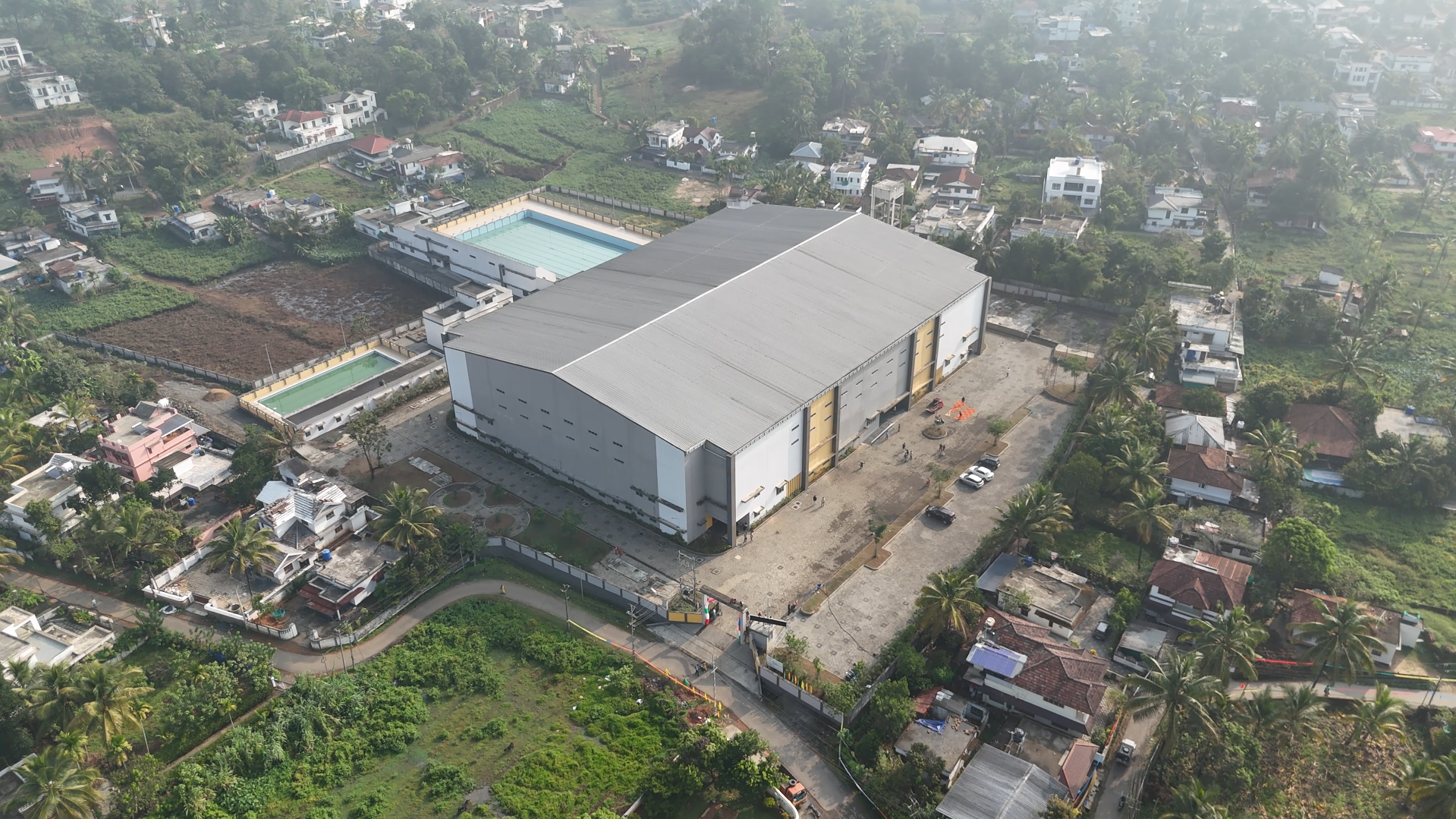
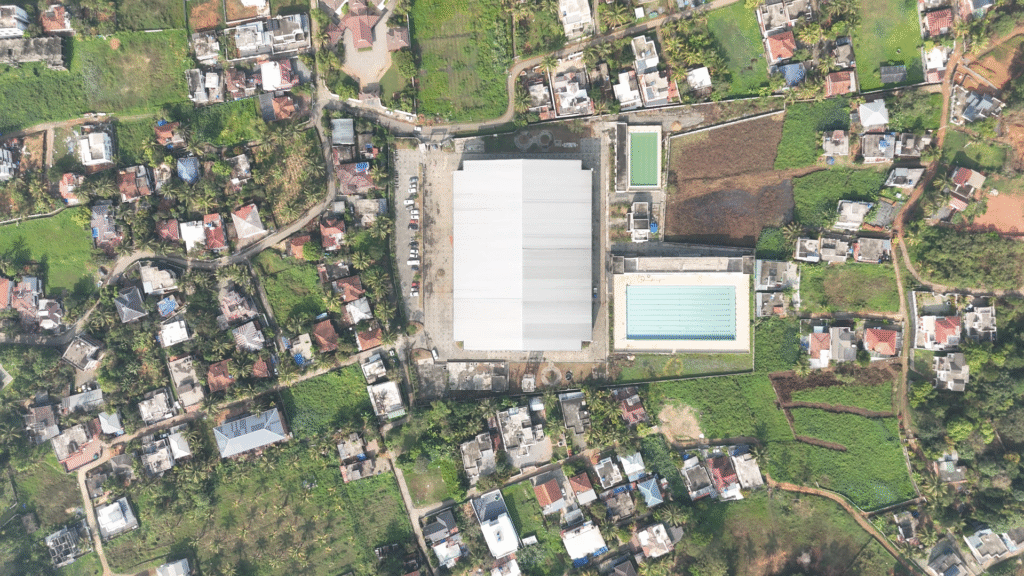
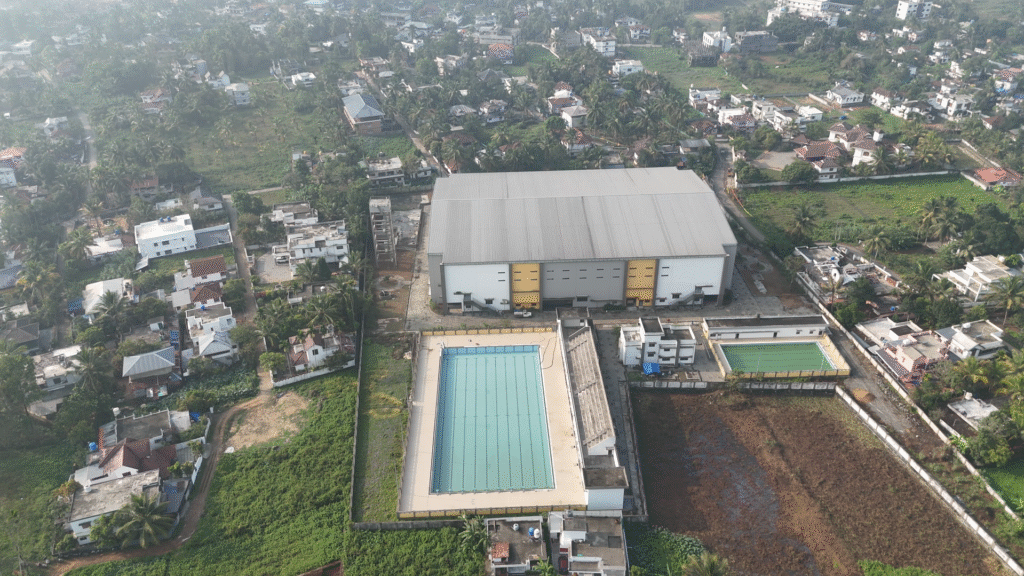
A 90 degree drone shot of Omkaranathan Indoor Stadium Kalppetta

Engineering Excellence: The 70-Metre Clear Span Structure

The most impressive feature of the Omkaranathan Indoor Stadium is the 70-meter clear-span roof.

The clear-span roof means that the roof is supported but that there are no pillars in the middle of the playing area. This is important because the playing area must be unobstructed.

The design of the roof of such a large space must be carefully calculated and constructed. Every part of the roof must be designed and constructed in such a way that the load is distributed evenly and that the roof is stable and long-lasting.

The construction of the Omkaranathan Indoor Stadium’s roof, which spans 70 meters without pillars in the middle, is a remarkable engineering feat.

The construction of the different parts of the roof and the transportation of the parts to the construction site required skill and precision. Every step of the construction of the roof must be carefully done.

The finished Omkaranathan Indoor Stadium is now one of the largest clear-span indoor stadiums in Kerala, showing the skill of Lee Builders.

Delivering a ₹38 Crore Project on Time

Large construction projects often face delays due to technical difficulties, environmental conditions, or logistical challenges. However, one of the most notable aspects of the Omkaranathan Indoor Stadium project is that it was completed on schedule despite the difficulties involved.

With a total project value of ₹38 crore, the stadium represents a major investment in sports infrastructure for the region.

Delivering such a project on time required:

  • Detailed project planning
  • Efficient resource management
  • Strong coordination between engineering and construction teams
  • Continuous monitoring of construction progress

The successful and timely completion of the project reflects the company’s commitment to professionalism and quality execution.

For communities waiting to use such facilities, timely project delivery is just as important as structural excellence.

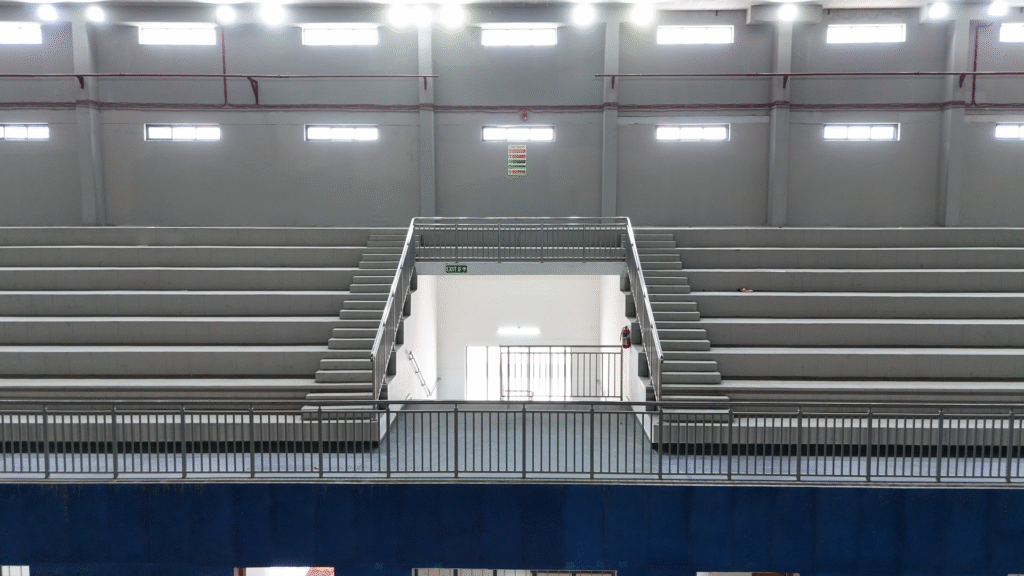
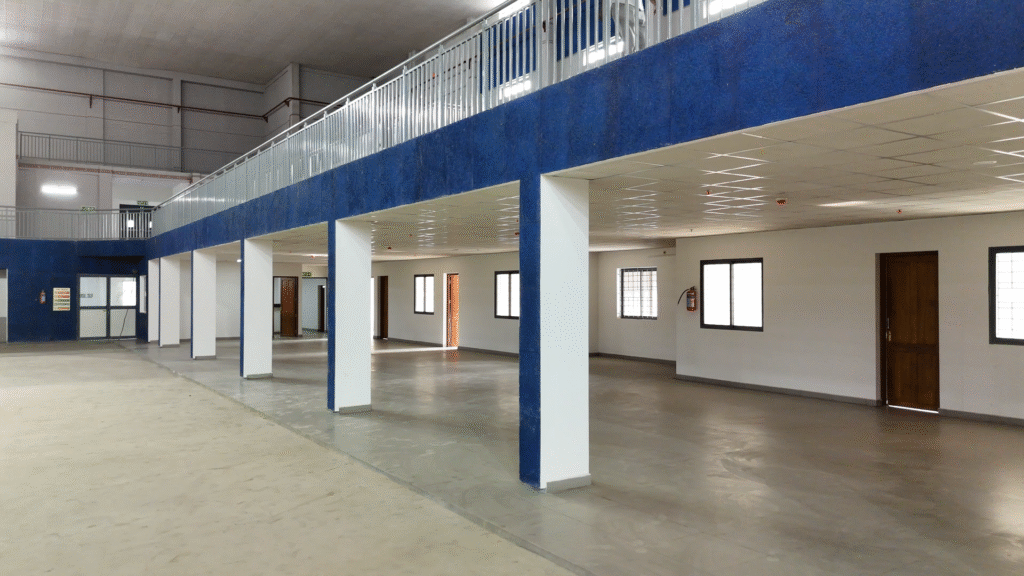
Inside the Omkaranathan Indoor Stadium Kalppetta
Inside the Omkaranathan Indoor Stadium Kalppetta 2

A Facility Designed for the Community

In addition to its engineering achievements, the Omkaranathan Indoor Stadium is an important civic center.

This building provides a venue for sporting activities and other events. Indoor stadiums are significant in fostering the development of sports culture among the populace. They provide athletes with an opportunity to train and compete in an indoor arena throughout the year.

In this case, the indoor stadium is expected to serve various sporting needs and make an impact in the development of sports in the district and state as well. Wayanad is known for producing great sporting talent. Therefore, this is an advantage to the district.

Lee Builders: Experience and Expertise in Construction

The successful execution of the Omkaranathan Indoor Stadium is an indication of the depth of knowledge that the company has in handling intricate construction works.

Lee Builders has been instrumental in the creation of various infrastructural developments in the state of Kerala over the years.

Projects of such magnitude do not simply require companies that excel in the construction arena. They require companies that have an in-depth knowledge of structural engineering.

The Omkaranathan Indoor Stadium Kalpetta stadium is an example of how all these facets come together in the hands of seasoned professionals.

Building Infrastructure that Lasts

These infrastructure initiatives are long-term investments that will contribute to the betterment of the community in the long term. Therefore, the quality of construction and the structural integrity of the infrastructure are of utmost importance.

Every aspect of the Omkaranathan Indoor Stadium, from its foundation to its roofing structure, has been executed with the principles of durability and safety in mind.

The use of quality materials and construction techniques, coupled with quality assurance procedures, has enabled the stadium to meet the standards set for a public infrastructure of such magnitude.

These infrastructure initiatives not only contribute to the betterment of the local community but also to the state’s infrastructure advancement.

Wide shot of Omkaranathan Indoor Stadium Kalppetta

A Landmark Achievement in Kerala’s Sports Infrastructure

Omkaranathan Indoor Stadium, situated in Kalpetta, can be classified as a modern sports infrastructure and an example of engineering prowess. The 70-meter clear span of the Omkaranathan Indoor Stadium, coupled with its scale and purpose, makes it one of the most distinguished indoor sports infrastructures in the state of Kerala. The Omkaranathan Indoor Stadium serves as an example that difficult conditions and logistical issues can be overcome with meticulous planning, proficiency, and strong teamwork. The construction of the ₹38 crore Omkaranathan Indoor Stadium marks another significant milestone for Lee Builders in its journey of constructing quality infrastructure projects in the state.

Conclusion

The story of the construction of the Omkaranathan Indoor Stadium in Kalpetta is not just about the construction itself; rather, it is the story of the realization of an idea into reality amidst the challenging topography, inclement weather, and complex logistical requirements.

From the inception of the project until its successful completion, Lee Builders has played an integral part in overseeing and accomplishing each step of the construction process.

The end result is the modern indoor stadium that houses a 70-meter clear-span construction, completed within the stipulated time frame and ready to meet the needs of the residents of Wayanad for generations to come.

As the athletes prepare and compete within the confines of the indoor stadium, the construction itself will stand the test of time as an example of what can be accomplished through the excellence of engineering, hard work, and cooperation.

Steel vs Concrete: Why Pre-Engineered Buildings Are the Future

Steel framework of a pre-engineered building under construction. Pre-engineered buildings (PEBs) are modern structures built from factory-made steel components. Each beam and column is cut and drilled off-site, then bolted together on-site, which dramatically shortens construction time and reduces waste. In Kerala – especially around Kochi, Aluva and Thrissur – these steel buildings are “increasingly popular” for everything from factories and warehouses to commercial and even residential projects. The result is a strong, durable building delivered much faster and often at lower cost than a comparable concrete structure. In fact, industry reports note that India’s PEB market reached about $1.84 billion in 2024 and is forecast to more than double by 2030. With advantages in speed, cost-efficiency and sustainability, pre-engineered steel buildings are rapidly outpacing traditional concrete construction in the region.

Steel vs Concrete: A Structural Showdown

Comparing the two approaches highlights why PEBs have the edge. Conventional concrete construction (cast-in-place or tilt-up) relies on heavy materials, on-site pouring and lengthy curing times. In contrast, a pre-engineered steel frame is delivered ready to assemble, so even large buildings go up quickly. Key differences include:

  • Weight and Span: Steel frames offer very long clear spans. For example, a pre-engineered steel building can cover over 300 feet between supports without interior columns. In a concrete building, the weight of walls and slabs requires frequent columns and supports, limiting open space.
  • Construction Speed: PEB components arrive prefabricated, so on-site assembly is fast. As one builder notes, a PEB’s “time-efficiency in fabrication and erection” is a foremost advantage. By contrast, concrete walls and slabs must be formed and cured on-site, which can add weeks or months. For instance, an indoor sports arena near Thrissur was constructed with a steel roof frame in half the time of a similar concrete build.
  • Safety and On-Site Impact: Less on-site construction means fewer hazards. Steel PEB frames are assembled quickly with cranes and bolts, creating a cleaner worksite. Studies note that steel construction is generally safer during erection, since concrete work involves heavier materials and wet processes.
  • Design Flexibility: Steel’s high strength-to-weight ratio allows custom shapes and expansions. Architects can design wide open interiors (ideal for factories, showrooms or gymnasiums) because steel beams easily carry loads over long distances. Modifications or future extensions are also simpler: new bays can be added by inserting more frames. Concrete’s rigidity makes late-stage design changes difficult.
  • Resilience: Pre-engineered steel buildings perform well under extreme conditions. Steel flexes in high winds or earthquakes while concrete tends to crack or fail. A quality steel frame resists tropical storms and seismic loads effectively, whereas a similarly strong concrete structure would be much costlier. Fire resistance is also comparable or better: steel does not burn, and modern coatings can increase its heat tolerance.

By these measures, PEBs clearly outclass conventional concrete for many building types. They minimize structural dead-weight, accelerate schedules, and create versatile spaces – making them ideal for modern industry and commerce.

Key Advantages of Pre-Engineered Buildings

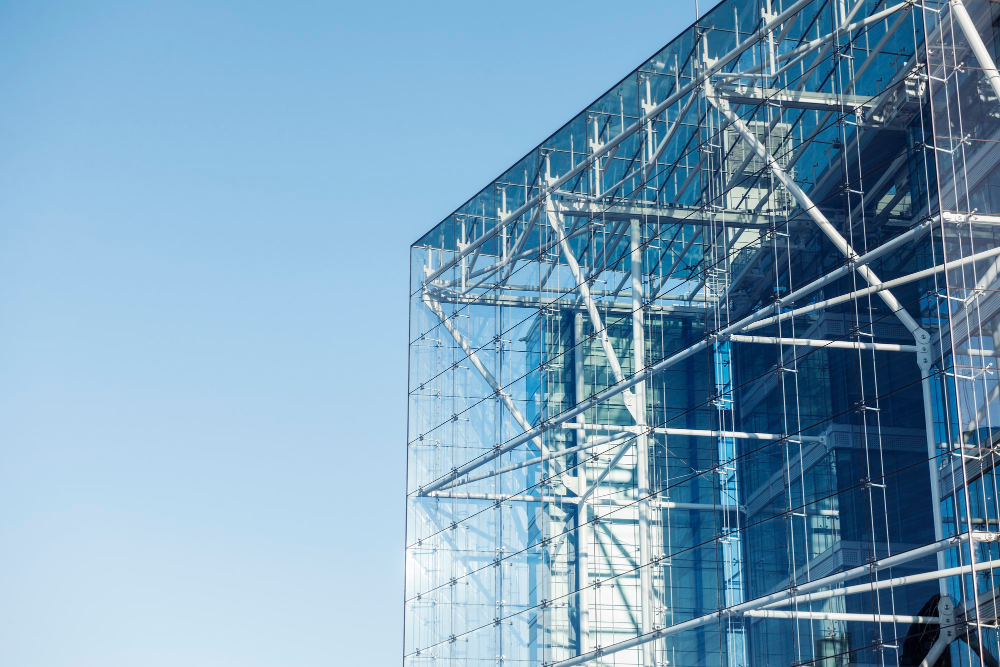
Close-up of complex steel framework in a modern pre-engineered building. Pre-engineered structures bring multiple benefits that make them attractive for today’s construction needs. As one supplier notes, the foremost advantage of a PEB is “time-efficiency in fabrication and erection” along with “value-effectiveness in material”. In practice, this means much faster builds with lower labor costs and minimal material waste. The key benefits of steel pre-engineered buildings include:

  • Rapid, Cost-Effective Builds: PEBs are engineered for speed. Since components are precision-cut in factories, projects assemble in a fraction of the time of concrete construction. This faster schedule also reduces labor expenses. Industry experts conclude that PEBs are often “more flexible, cost-efficient, and quick” than traditional methods. For example, a concrete warehouse might take half a year to complete, whereas a similar steel PEB can often finish in weeks.
  • Design Flexibility: Steel’s strength lets developers create large open layouts and accommodate specialized equipment. Clear-span interiors (up to 300+ ft) are routine, benefiting uses like warehouse racking, retail showrooms or recreational centers. Steel buildings also allow easy future expansion; new bays or mezzanines can be added by extending the frame. Custom roof shapes, clerestory windows or large overhangs are straightforward with pre-engineered components.
  • Durability and Low Maintenance: Steel frames resist many issues that plague concrete. Unlike wood, steel doesn’t rot or host termites, and it endures weather extremes without cracking. A well-built PEB can last 50 years or more with very little upkeep. This long lifespan means fewer replacements and lower lifecycle costs. Many manufacturers emphasize that PEBs require “less maintenance” over decades, making them a smart investment.
  • Sustainability: Pre-engineered steel construction is inherently eco-friendly. Factory fabrication wastes very little material – one study points out that steel PEB components are “custom-made… ensuring only essential material is used”. Excess scrap is minimal, and steel is highly recyclable (often 100% at end-of-life). In fact, current industry trends highlight steel’s recyclability and reuse as major green advantages. Steel PEB kits also often include insulated metal panels, which deliver excellent thermal performance and reduce energy use.
  • Safety and Resilience: PEBs tend to have lower on-site risks. Steel parts arrive pre-cut, so there is less messy concrete work to slow progress or create hazards. Moreover, steel structures are engineered to withstand extreme events – for instance, many can resist winds over 200 mph – without catastrophic failure. Their ductility means steel bends and recovers in strong forces, enhancing occupant safety in storms or quakes.

These advantages make pre-engineered steel buildings an attractive choice for a wide range of projects. Commercial developers, industrial firms, and even institutional clients gain from shorter timelines, predictable costs and robust performance. Government and public agencies also favor PEBs for infrastructure and facility projects that demand fast delivery without sacrificing quality.

Pre-Engineered Buildings in Kochi, Aluva, and Thrissur

The shift toward PEBs is especially noticeable in Kerala’s major cities. Local construction markets have rapidly adapted to steel framing:

  • Local Demand & Search: In Kochi, Thrissur and Aluva, online searches for pre engineered building in Kochi, “pre engineered buildings in Aluva” or even “new building construction near me” often list specialized PEB contractors. This reflects strong demand for steel-based solutions. Many developers and investors are finding that reputable PEB providers appear at the top of local search results, making it easy to find turnkey options nearby.
  • Contractors & Services: Many of the best construction companies in Kochi (and Thrissur) now offer PEB expertise. Leading firms provide full turnkey construction company services – from detailed steel frame design and permitting to fabrication and on-site erection. These local builders have invested in the necessary equipment and training to handle steel projects end-to-end. By advertising PEB capabilities on their websites and in bids, they signal that steel framing is a core part of modern construction services.
  • Manufacturers & Specialists: Regional PEB manufacturers have established a strong presence. For example, Tapco Smart Builders is noted as “a leading Pre-Engineered Building Manufacturer in Kochi”. Likewise, Lee Builders (based near Kochi) markets itself as a trusted PEB contractor serving Kochi and Thrissur. These companies combine advanced engineering with local know-how. By using locally made steel components and crews familiar with Kerala’s climate and regulations, they deliver high-quality buildings efficiently. In short, both building contractors in Kochi and building contractors in Thrissur now emphasize steel framing on par with traditional methods.

This local ecosystem means anyone in the Kochi region can capitalize on PEB technology. Investors and business owners can easily find qualified construction companies in Kochi to execute a steel building. Even for general public or residential projects, pre-fab steel modules are becoming an option. (Indeed, one industry report notes that “even modern residences are sometimes built using PEB modules” for faster construction.) The combination of skilled contractors, nearby manufacturers, and strong demand makes Kochi, Aluva, and Thrissur fertile ground for the PEB trend.

Choosing a Pre-Engineered Building Provider

When planning a new steel building, it pays to select the right manufacturer and contractor. Key considerations include:

  • Full-Service Manufacturers: Look for firms that act as a true Pre Engineered Building Manufacturer, offering end-to-end solutions. The top providers handle everything from structural design to fabrication to on-site assembly and commissioning. For example, Green Brick Project in Kochi advertises integrated PEB services – they manage detailed engineering, procurement, project management and installation as a package. This one-stop approach reduces coordination headaches and ensures compatibility of all components.
  • Proven Track Record: Choose contractors with experience in steel projects. The best builders in Kochi and Thrissur have portfolios showing completed PEB warehouses, offices or halls. Verify that their work meets standards (e.g. they use certified steel grades and precise connections). For instance, Lee Builders’ local website highlights its history of PEB projects, underscoring its reputation as “a leading PEB manufacturer” in the region. Reviewing case studies and client testimonials can reveal which companies deliver on time and quality.
  • Turnkey Construction Services: Ensure the contractor provides comprehensive construction company services. This means they handle approvals, foundations, roofing, cladding, electrical and plumbing as part of the steel building package. Local PEB contractors often bundle these with the steel framing, so you don’t have to subcontract each phase. Check that they can coordinate finishes like insulation, facades and utilities to your specifications.
  • Search & Keywords: When researching providers, use targeted search terms. Phrases like “Pre Engineered Building Manufacturer Kochi”, “building contractors in Kochi”, or even “new building construction near me” can surface specialized firms. Many local companies optimize for these keywords online, so this is a good way to identify reputable local partners.

By partnering with a qualified PEB manufacturer and contractor, developers and clients ensure a smooth project. The right team will maximize the speed, safety and quality that steel construction promises.

Conclusion

Across sectors, pre-engineered steel buildings are proving their worth. From developers and investors to government planners and the general public, PEBs deliver what concrete cannot: faster completion, lower total costs, and greater flexibility. One industry analyst sums it up: pre-engineered steel structures are often “the clear winner” in a head-to-head with traditional construction, thanks to their efficiency and resilience. In Kerala’s booming economy, cities like Kochi, Thrissur and Aluva have seen PEBs become the go-to choice for new projects. Even complex facilities – from sports arenas to industrial sheds – are now routinely built with steel frames to meet tight deadlines and budgets.

For businesses, developers and government bodies, this means future-proof construction. Pre-engineered buildings offer long-term value: durable steel frames that last decades, lower maintenance, and a smaller carbon footprint from reduced waste. As local experts note, well-designed PEB projects rank among the “best pre engineered buildings” for performance and sustainability.

In summary, whether planning a new warehouse, mall, school or office, decision-makers in Kochi, Aluva and Thrissur should strongly consider steel PEB technology. Its combination of speed, strength and cost-effectiveness is unmatched. By choosing skilled PEB manufacturers and contractors, commercial developers, residential clients and public agencies alike can build smarter, faster and greener – truly making pre-engineered steel buildings the future of construction in the region.

Industries That Benefit Most from Pre-Engineered Buildings

Pre-engineered buildings (PEBs) – prefabricated steel structures designed off-site and assembled on-site – are revolutionizing construction with their versatility, durability, and cost-effectiveness. These buildings offer quick installation and large column-free spans, making them attractive to many sectors. For example, searches like Pre engineered building in Kochi or new building construction near me often yield local PEB specialists, reflecting strong demand in Kerala’s growing urban centers (Kochi, Thrissur, Aluva). Local contractors and manufacturers (such as Lee Builders of Perumbavoor) have emerged as leading PEB providers, offering comprehensive construction company services from design to installation. In the paragraphs below we examine key industries that most benefit from PEB solutions.

Warehousing and Logistics

The warehousing and logistics industry gains major advantages from PEBs. Modern warehouses and distribution centers require vast clear-span interiors for storage racks, conveyor systems, and material handling. PEBs naturally provide these large column-free spaces, maximizing storage and workflow efficiency. In addition, the rapid construction of prefabricated steel frames helps logistics companies quickly expand capacity to meet e-commerce and global trade demands. Steel PEB warehouses also resist fire and weather damage better than many conventional structures, protecting goods. In Kerala, for example, many new warehouses in industrial zones near Kochi and Aluva are being built as PEBs to speed up deployment of storage facilities.

Manufacturing and Industrial Facilities

Manufacturing plants and industrial units are another prime PEB market. Steel-framed PEBs are engineered to support heavy machinery, cranes, mezzanines, and other industrial equipment. Industries like automotive, textiles, heavy machinery and metal fabrication favor PEBs for their strength and durability. The prefabricated nature means high precision: fewer material waste and faster assembly allows factories to come online sooner and with lower cost. For example, many of the chemical, pharmaceutical, and rare-earth processing plants in Kerala’s industrial parks choose PEBs because they can handle corrosive environments (with appropriate coatings) and allow future expansion with minimal disruption. As one industry analyst notes, PEBs’ robust steel frameworks reduce long-term maintenance and provide flexibility for plant reconfiguration.

Retail and Commercial Spaces

Retailers and commercial developers also benefit from PEB design flexibility. PEBs create large open interiors ideal for shopping malls, supermarket chains, showrooms and exhibition halls. Stores can lay out aisles, product displays and checkout areas freely without columns getting in the way. Architects can add aesthetic touches to facades and interiors even though the frame is prefabricated, so brand image and customer experience aren’t compromised. The speed of PEB construction is a further plus: a new showroom or mall can be built in a fraction of the time required by traditional concrete construction. For example, several new retail complexes in Kochi and Thrissur have used PEB shells with decorative exteriors, cutting opening delays by months.

Aviation and Transportation

The aviation and transport sector needs very large, unobstructed spaces for hangars, terminals, bus depots, and maintenance facilities. PEBs deliver exactly that: wide clear spans with no internal columns allow aircraft, buses and heavy vehicles to park and be serviced easily. High-ceiling PEB hangars handle oversized aircraft, and the durable steel frame withstands environmental stresses (high winds, heavy rain or even seismic loads) important for airports and coastal terminals. Airports around the world increasingly use PEB hangars for these reasons. In Kerala, the Cochin International Airport and local transport authorities have investigated steel PEB designs for cargo sheds and vehicle workshops, citing their scalability and safety under tropical weather conditions.

Agriculture and Food Processing

Agricultural industries use PEBs for barns, cold storage, and processing plants. Steel PEB sheds provide clean, temperature-controlled spaces needed to store grains, tea, spices or dairy products safely. Insulated PEB panels create controlled environments, which is critical for cold storage of produce or meats. Food processing factories (such as rice milling or fish processing) also benefit: PEBs can be built to meet strict hygiene and ventilation standards and expanded later if needed. Indeed, prefabricated cold stores in Kerala’s food parks often use PEB frames with sandwich panels to ensure long-term energy efficiency. Because PEBs cost less and erect faster, farmers and agri-entrepreneurs see them as cost-effective solutions, whether in rural warehouse projects or urban vegetable markets.

Sports and Recreational Facilities

Large sports and recreational complexes – gymnasiums, indoor stadiums, swimming pools, community centers – commonly use PEB structures. The long clear spans allow uninterrupted play areas and audience seating. Custom roof curves and eaves can be prefabricated to specific dimensions for courts and pools. As one source notes, PEBs allow “interrupted play areas and seating arrangements” to be designed without interior columns. Many communities in Kerala are turning to PEBs for affordable gymnasiums and halls that require minimal maintenance over decades. For example, a recent indoor sports arena near Thrissur was built with a steel roof structure and cladding in half the time of a conventional build, yet with the same durability and insulation.

Institutional and Other Sectors

Beyond these industries, PEBs are also used in institutional projects. Educational campuses, hospitals, and hotels adopt PEBs for fast turnaround and flexibility. Classrooms, dormitories and wards built with prefabricated steel frames can be customized internally (partition walls, utilities) while the shell goes up quickly. Healthcare facilities benefit from PEBs’ strong hygiene control and durable walls. In fact, one industry summary highlights that “educational institutions and healthcare facilities benefit from the versatile designs of PEBs”. Even modern residences are sometimes built using PEB modules (custom homes assembled from factory-made steel parts), offering speedier construction with high strength.

Pre-Engineered Buildings in Kochi, Thrissur, and Aluva

In Kerala’s major cities – Kochi, Thrissur, Aluva – PEB adoption is rising. Local demand shows up in search terms: queries like “pre engineered building in Kochi”, “pre engineered building in Thrissur”, or “pre engineered buildings in Aluva” frequently return regional PEB specialists. Several Kerala-based firms have positioned themselves as top PEB manufacturers. For example, Tapco Smart Builders is described as “a leading Pre-Engineered Building Manufacturer in Kochi, Kerala” offering customized PEB solutions for industry, commerce and residence. Likewise, Lee Builders (based in Perumbavoor) highlights its role as a trusted PEB contractor: “Lee Builders transform your vision into reality as trusted building contractors in Kochi and Thrissur,” delivering industrial, commercial and PEB projects across the state.

Many of the best construction companies in Kochi (and Thrissur) now include PEB in their services. These firms and building contractors provide full-service “construction company services” – from steel-frame design and permitting to on-site erection and finishing. They often advertise with keywords like “Pre Engineered Building Manufacturer” and “new building construction near me” to capture clients searching locally. Indeed, by partnering with local PEB manufacturers, businesses in Kochi and Aluva can tap into turnkey PEB solutions that combine speed, quality and sustainability. As one industry source observes, well-designed PEB projects are often among the best pre engineered buildings in terms of long-term performance and efficiency.

Conclusion

Across sectors, pre-engineered buildings are proving their worth. From warehousing and manufacturing to retail and sports, PEBs offer flexible, scalable structures that cut costs and time. In Kerala’s economy, as industries grow in Kochi, Thrissur and Aluva, PEBs are becoming a go-to choice for developers and investors. Local firms like Lee Builders and Tapco Smart Builders exemplify how regional expertise is making PEBs accessible – they combine advanced engineering with proven construction company services. For business owners and stakeholders looking into new building construction, understanding how PEBs can speed up delivery while ensuring durability is key. By working with reputable PEB manufacturers and contractors, clients in Kerala can secure high-quality, eco-friendly buildings that serve their industries’ unique needs.


Are Pre-Engineered Buildings (PEBs) Environmentally Friendly in Kerala?

Pre-engineered buildings (PEBs) are modern structures built from prefabricated steel frames. They are increasingly popular in Kerala for warehouses, factories, and even residential and commercial projects. Advocates note that PEBs can reduce construction time and costs, but a key question is whether they are eco-friendly. In this article, we examine factors like material efficiency, energy efficiency, and durability to see how PEBs measure up environmentally. We also discuss how local PEB providers and construction company services in Kochi, Aluva, and Thrissur contribute to sustainable building practices in Kerala.

Material Efficiency

One major environmental advantage of PEBs is material efficiency. Since PEB components are precisely engineered in factories, builders use only the necessary amount of steel, which minimizes off-cuts and scrap. For example, modern PEB frameworks are made of high-quality, lightweight steel that can be cut exactly to design specifications, so the construction process generates very little waste. In fact, steel PEB components are typically fully recyclable – one report notes that steel used in PEBs is “100% reusable” and produces far less waste than conventional concrete construction. Key points include:

  • Precision fabrication: PEB components are custom-made for each project, ensuring only essential material is used.
  • Recyclable steel: Structural steel often contains up to 88% recycled content, and the steel from a building can be completely recycled at end-of-life (Steel frames are among the most recyclable construction materials.)
  • Minimal scrap: Compared to brick-and-mortar projects, PEB construction typically creates much less leftover material and demolition debris.

Together, these factors make pre-engineered projects highly resource-efficient. By cutting down on raw material use and maximizing recycled content, PEBs align well with green building principles.

Energy Efficiency

PEBs can also excel in energy efficiency. The design and insulation of steel buildings often reduce heating, cooling, and lighting demands over the building’s life. Key features include:

  • High-performance insulation: Many PEB systems use insulated roof and wall panels. These panels provide excellent thermal barriers, cutting down air-conditioning and heating needs. In fact, prefab steel buildings frequently boast “energy-efficient insulation” that lowers their carbon footprint
  • Passive design elements: Builders often incorporate skylights, large windows, and ventilation options into PEB designs. These elements maximize natural daylight and airflow, which can dramatically reduce artificial lighting and HVAC usage
  • Tight building envelope: Factory fabrication ensures a precise fit between panels and components, minimizing air leaks. This optimized envelope further improves overall energy performance.

As a result, a well-designed PEB can consume significantly less energy in daily operation compared to a poorly insulated traditional building. In Kerala’s humid climate, the ability to naturally ventilate and rapidly cool large spaces is especially beneficial, helping to lower both electricity use and carbon emissions.

Durability

Durability is another area where PEBs offer environmental benefits. A long-lasting building requires fewer repairs and replacements, which conserves resources over time. Steel PEB structures are inherently strong and resilient:

  • Resistant to pests and decay: Unlike wood, steel does not rot or attract termites. Steel frames are largely immune to mold and insects, eliminating the need for chemical treatments. They are also fire-resistant, which enhances safety in Kerala’s humid, fire-prone conditions
  • Weather resilience: PEBs are engineered to withstand extreme weather. High-grade steel structures can resist heavy rainfall and strong winds common in Kerala’s monsoons. Properly designed PEB frames can endure cyclones and even seismic events, making them well-suited for disaster-prone regions.
  • Low maintenance, long life: Coated steel requires minimal upkeep. A properly constructed PEB can easily last 50 years or more with little repair, far exceeding the lifespan of many traditional buildings.

These durability features mean fewer resources spent on renovations or rebuilds. By avoiding repeated repairs, PEBs reduce the material and energy footprint over the building’s lifetime, further supporting sustainability.

PEBs in Kochi, Aluva, and Thrissur

PEBs have become widely adopted across Kerala, especially in urban and industrial areas. Local availability of expertise makes these projects feasible and eco-friendly:

  • Pre Engineered Building Manufacturer: Kerala hosts several specialized PEB manufacturing firms. For example, Lee Builders is a leading PEB manufacturer in Kochi and Thrissur. These companies design and fabricate the steel components using efficient, sustainable methods, ensuring high-quality, green buildings for local projects.
  • Construction & Contractor Services: Many of the best construction companies in Kochi (and Thrissur) now offer turnkey PEB solutions. Local building contractors in Kochi and building contractors in Thrissur have experience with steel-frame assembly. These firms provide end-to-end construction company services – from structural design and permitting to on-site erection – integrating eco-friendly practices at each step.
  • Search & Availability: In Kerala cities like Kochi, Thrissur, and Aluva, looking up pre engineered building in Kochi, pre engineered building in Thrissur, pre engineered buildings in Aluva, or “new building construction near me” often returns local PEB specialists. This reflects strong demand for sustainable steel construction. Local contractors and construction companies in Kochi leverage these keywords to promote PEB projects, making it easy for buyers to find green building solutions nearby.

Overall, the PEB industry in Kerala is well-positioned to support environmentally friendly construction. The combination of local manufacturing and skilled contractors means that clients can build quickly and sustainably.

Conclusion

In summary, pre-engineered buildings can indeed be an environmentally friendly choice for Kerala. They use materials efficiently (with minimal waste and high recyclability), offer energy-efficient designs (through insulation and passive features), and deliver durable, long-lasting structures that resist harsh climate and pests. These advantages make PEBs a smart fit for Kerala’s focus on green infrastructure. For those in Kochi, Aluva, Thrissur and beyond, partnering with a reputable PEB provider or construction contractor means getting a new building that is both high-performance and eco-conscious. In fact, experts note that well-designed PEB projects are often among the best pre engineered buildings in terms of sustainability. By choosing qualified PEB manufacturers and contractors, developers ensure their new construction aligns with Kerala’s environmental goals.


Pre-Engineered Buildings: Weighing the Pros and Cons

In the world of construction, pre-engineered buildings (PEBs) have emerged as a game-changer for industries, commercial enterprises, and even residential projects. These structures, designed off-site and assembled on-location, promise speed, efficiency, and cost savings. But like any innovation, they come with their own set of trade-offs. Let’s look into the advantages and disadvantages of pre-engineered buildings and explore why partnering with the best pre-engineered builders matters more than you might think.  

 What Are Pre-Engineered Buildings?  


Pre-engineered buildings are structures fabricated in factories using standardized components. Unlike traditional construction, where materials are cut and assembled on-site, PEBs rely on pre-designed steel frames, walls, and roofing systems tailored to a project’s specifications. This method streamlines the building process, reduces waste, and often slashes timelines. From warehouses and factories to schools and aircraft hangars, PEBs are reshaping how we think about construction.  


But are they the right choice for every project? Let’s break it down.  

Advantages 


  1. Speed of Construction  

Time is money, and nowhere is this truer than in construction. PEBs excel here. Since components are prefabricated in controlled factory environments, weather delays and on-site errors are minimized. A skilled team can erect a PEB in weeks, not months. For businesses needing rapid expansion (think logistics hubs or manufacturing units), this speed is invaluable.  


  1. Cost-Effectiveness  

PEBs are often cheaper than traditional buildings. Standardized designs reduce material waste, and bulk purchasing of steel lowers costs. Labor expenses also drop, as fewer workers are needed for assembly. For budget-conscious projects like agricultural warehouses or small-scale factories, these savings can make or break feasibility.  


However, cost isn’t just about upfront expenses. PEBs’ durability, thanks to corrosion-resistant steel and engineering, translates to lower maintenance costs over decades.  


  1. Design Flexibility  

Contrary to the myth that PEBs are “one-size-fits-all,” modern systems allow impressive customization. Builders can adjust spans, heights, and layouts to accommodate cranes, machinery, or even intricate architectural features. 


  1. Durability and Safety  

Steel, the backbone of PEBs, is inherently strong and resistant to pests, fire, and extreme weather. When engineered correctly, these buildings withstand cyclones, heavy rains, and seismic activity, critical in disaster-prone regions like Kerala. Reputed builders also integrate advanced safety features, from fire-resistant insulation to lightning protection systems.  


  1. Sustainability  

PEBs are eco-friendly by design. Steel is recyclable, and precision manufacturing reduces material waste. Builders can also incorporate energy-efficient elements like insulated panels, skylights, and solar-ready roofs. For companies aiming to meet green certifications, PEBs offer a clear path.  

 Disadvantages of Pre-Engineered Buildings  

  1. Limited Aesthetic Appeal  

While PEBs have come a long way, they still lag behind traditional buildings in visual sophistication. Most industrial PEBs prioritize function over form, resulting in boxy, utilitarian designs. For projects where aesthetics matter—luxury resorts, high-end retail spaces they may fall short unless paired with custom cladding or facades.  


  1. Transportation and Space Challenges  

PEB components are manufactured off-site and transported to the location. For remote areas with poor road access, this can pose logistical nightmares. Oversized beams or panels might require special permits or equipment, adding to costs. Additionally, sites with limited space for staging and assembly may face delays.  


  1. Perception Issues  

Many still associate PEBs with “temporary” structures like storage sheds or roadside stalls. Convincing clients to use them for permanent projects (e.g., schools, offices) requires education. This stigma is fading as more landmark projects like Cochin Shipyard’s 70,000 sq.ft. assembly unit showcase PEBs’ potential, but it remains a hurdle.  


  1. Customization Limits  

While PEBs are flexible, radical deviations from standard designs can erase cost and time savings. A client wanting intricate domes or irregular shapes may find traditional construction more practical. However, top builders often strike a balance by blending PEB frameworks with conventional elements where needed.  


  1. Upfront Engineering Costs  

PEBs require precise engineering upfront. Any design flaws or measurement errors can derail the entire project, as components are pre-cut. This makes the initial planning phase critical—and sometimes expensive. Skimping on skilled engineers or software tools is a recipe for disaster.  

 When Should You Choose a Pre-Engineered Building?  


PEBs shine in scenarios where speed, budget, and functionality trump ornate design:  

– Industrial Projects: Factories, warehouses, cold storage.  

– Commercial Spaces: Showrooms, workshops, gyms.  

– Agricultural Needs: Grain storage, poultry farms.  

– Emergency Infrastructure: Disaster relief shelters, temporary hospitals.  


For projects requiring unique aesthetics or heritage designs, traditional methods may still prevail.  


How the Best Pre-Engineered Builders Make a Difference  


Consider the case of a Kochi-based gloves manufacturer. They needed a 40,000 sq.ft. factory with 20-ton crane systems and humidity control. A mediocre builder might have delivered a basic shed, but a top-tier PEB firm:  

  1. Conducted a site-specific wind and seismic analysis.  
  2. Integrated crane rails directly into the steel framework.  
  3. Used insulated panels to maintain consistent indoor temperatures.  
  4. Completed the project 30% under budget and two weeks early.  


This underscores the importance of choosing experienced builders. We don’t just assemble structures, we solve problems. 

 Conclusion  

Pre-engineered buildings are neither a magic bullet nor a compromise. They’re a tool that offers unmatched efficiency for the right projects. The advantages speed, cost savings, durability are transformative for industries racing against time and budgets. The disadvantages—limited aesthetics, logistical hurdles—are manageable with careful planning and skilled partners.  


If you’re considering a PEB, invest time in selecting the best pre-engineered builders. Look for firms with a portfolio of diverse projects, in-house engineering teams, and a reputation for transparency. After all, even the strongest steel frame is only as good as the hands that assemble it.  


In Kerala’s fast-growing industrial landscape, PEBs aren’t just buildings; they’re the backbone of progress. Whether you’re erecting a warehouse in Kochi or a workshop in Thrissur, understanding these pros and cons ensures you build smarter, not just faster.