





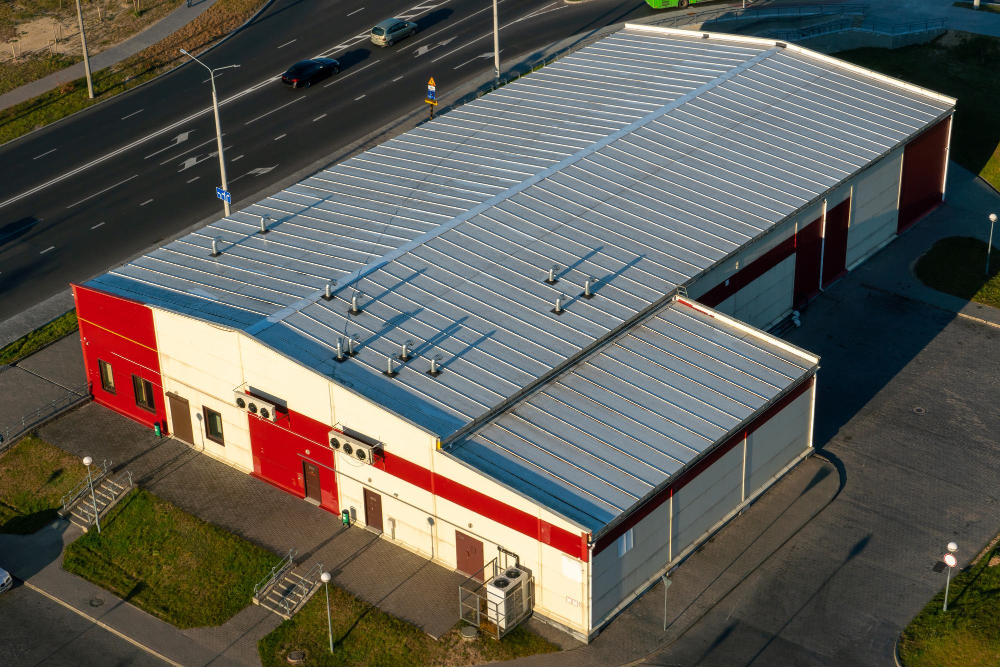
Manufacturing has changed. Production lines move faster, equipment is heavier and more automated, and facilities need to scale up or reconfigure with little notice. Conventional construction methods, built around brick, concrete, and long curing times, often struggle to keep pace with these demands.
Reinforced concrete cement (RCC) buildings can take many months to complete, limit column-free space, and become expensive to modify once production needs change. For manufacturers competing on speed to market and operational efficiency, this is a real constraint.
Steel structures have emerged as the practical answer. From automotive plants to food processing units, industrial steel buildings now form the backbone of modern manufacturing facility construction across India and globally, offering a combination of speed, strength, and adaptability that conventional construction cannot easily match.
Table of Contents
What Are Steel Structures for Manufacturing Facilities?
A steel structure for manufacturing is a building system built around a structural steel frame, typically composed of columns, rafters, purlins, and bracing, fabricated to precise engineering specifications and assembled on site.
The core components generally include:
- Primary structural steel frame (columns and rafters) that carries the main building loads
- Secondary members such as purlins and girts that support roofing and wall cladding
- Roofing and wall cladding sheets, often insulated for thermal performance
- Bracing systems for lateral stability against wind and seismic forces
- Foundations designed specifically for steel column loads
Many modern manufacturing buildings use pre-engineered buildings (PEB), where the steel fabrication is standardized and optimized in a factory setting before being shipped for on-site assembly. PEB buildings are widely used for steel factory buildings, industrial steel sheds, warehouses, and large-span production halls.
Why Steel Structures Are the Preferred Choice
Large Clear Spans Enable Better Production Layouts
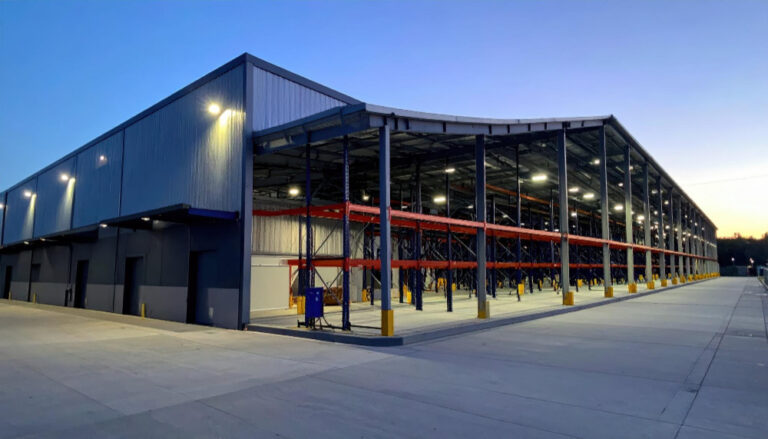
One of the most valuable features of clear span steel buildings is the ability to cover large floor areas without internal columns interrupting the space.
This matters enormously on a factory floor. Column-free interiors mean machinery can be positioned according to the most efficient production sequence rather than around structural obstructions. Material handling equipment such as forklifts and conveyor systems can move freely, and production lines can be laid out, and later reconfigured, without working around columns.
For example, an automotive parts manufacturer running a linear assembly line benefits directly from a clear span layout, since the entire line can be repositioned or extended as new equipment is introduced, something far harder to achieve in a column-heavy RCC shed.
Heavy Load Capacity Supports Industrial Equipment
Modern manufacturing relies on heavy-duty steel structures to support overhead cranes, heavy machinery, mezzanine floors, and bulk storage systems.
Steel’s high strength-to-weight ratio allows structural engineers to design frames that handle substantial point loads and dynamic loads, such as those from gantry or EOT cranes, while keeping the overall structure efficient and stable.
Industries that depend heavily on this load capacity include:
- Automotive manufacturing, where overhead cranes move engines and body panels
- Steel fabrication units handling heavy plate and structural members
- Engineering and heavy machinery production facilities
- Cement and building material plants with heavy storage and processing equipment
- Food processing facilities with mezzanine-mounted processing lines
- Textile manufacturing units with multi-level storage and machinery
Safety remains central to this design process. Structural steel frames are engineered to recognized codes, ensuring stability under both static and dynamic industrial loads.
Exceptional Durability for Long-Term Operations
A well-designed and properly coated steel structure offers a long service life with comparatively low maintenance requirements.
Corrosion-resistant coatings, galvanization, and modern paint systems protect steel against weather exposure, while properly detailed buildings resist termites and rot entirely, an advantage over timber-based or poorly maintained masonry construction.
Fire-resistant coatings and design measures are also available where manufacturing processes carry higher fire risk. Combined with consistent structural integrity over time, these durability features translate into lower lifecycle costs, since the facility requires fewer major repairs across its operational life.
Flexible Layouts for Evolving Manufacturing Needs
Manufacturing requirements rarely stay static. Production volumes grow, new equipment is introduced, and product lines change. Steel structures are inherently suited to this kind of evolution.
Because PEB buildings and structural steel frames are modular by nature, facilities can be expanded by adding bays along the building length, without disrupting ongoing operations in the existing structure. Machinery can be relocated more easily within a column-free layout, and additional office space, warehousing, or mezzanine areas can be integrated into the original design or added later.
This flexibility directly reduces the cost and disruption of future renovation, since expansion is largely a matter of extending the existing structural system rather than redesigning a building from scratch.
Additional Advantages of Steel Structures
- Faster construction timelines, since steel components are fabricated off-site in parallel with foundation work
- Cost-effectiveness from reduced construction time, labor, and simpler foundation requirements
- Sustainability, as steel is highly recyclable and generates less construction waste than masonry methods
- Energy efficiency when combined with insulated roofing and wall systems
- Reduced operational downtime during expansion, since work can proceed without shutting down the entire facility
- Lower maintenance costs over the building’s operational life
- Better quality control, since structural members are fabricated under factory conditions
- Precision engineering that ensures components fit accurately during on-site assembly
Industries That Benefit Most
While nearly every manufacturing sector can benefit from steel industrial buildings, some industries rely on them especially heavily:
- Automotive manufacturing, for large assembly halls and crane-supported production
- Food processing, where hygienic cladding and clear spans support processing lines
- Pharmaceutical plants, requiring controlled environments and flexible layouts
- Textile manufacturing, with large open floors for spinning and weaving equipment
- Electronics manufacturing, needing clean, column-free assembly areas
- Engineering workshops, with heavy fabrication and crane requirements
- Heavy machinery production, requiring high load capacity structures
- Chemical industries, often needing specialized fire and corrosion protection
- Packaging industries, with high-throughput, flexible production lines
- FMCG manufacturing, where speed of construction supports fast market entry
Steel Structures vs Conventional RCC Manufacturing Buildings
The table below summarizes the key differences manufacturers typically weigh when comparing industrial building construction options.
Factor | Steel Structures | Conventional RCC |
Construction Speed | Significantly faster; factory-fabricated components | Slower; on-site curing and formwork required |
Cost | Lower overall project cost in most cases | Higher material and labor cost over time |
Flexibility | Easy to modify, extend, or relocate | Difficult and costly to alter |
Clear Span Capability | Long clear spans with minimal columns | Limited spans; more columns needed |
Maintenance | Low maintenance with protective coatings | Higher maintenance due to cracking, seepage |
Expansion | Modular, supports phased expansion | Structural redesign often required |
Load Capacity | High strength-to-weight ratio for heavy loads | Heavier structure for comparable load capacity |
Sustainability | Recyclable steel, less construction waste | Higher resource consumption, more waste |
Lifecycle Cost | Lower lifecycle cost with proper maintenance | Higher lifecycle cost due to repairs |
Project Completion Time | Weeks to a few months for typical facilities | Several months to years |
Factors to Consider Before Choosing a Steel Structure
Steel structures offer significant advantages, but the right outcome depends on getting the design fundamentals right from the start. Key factors include:
- Building size and the overall footprint required for current and future operations
- The specific production process and how it dictates layout, clearances, and ventilation
- Crane requirements, including capacity, span, and travel height
- Future expansion plans and how the structural design accommodates them
- Environmental conditions such as wind, seismic zone, and coastal corrosion exposure
- Local building codes and compliance with relevant Indian Standards (IS Codes)
- Quality of steel used and adherence to recognized fabrication standards
- Design expertise of the structural engineering and fabrication team
- Foundation requirements based on soil conditions and column loads
Conclusion
Modern manufacturing demands infrastructure that can keep pace with changing production needs, heavier equipment, and tighter project timelines. Steel structures meet these demands directly, offering large clear spans, high load capacity, exceptional durability, and the flexibility to expand without costly rework.
For manufacturing business owners, developers, and engineers evaluating their next facility, steel structures represent a long-term investment that supports better ROI, operational efficiency, and scalability compared to conventional RCC construction.
If you are planning a new manufacturing facility or considering an expansion, it is worth consulting experienced steel building specialists who can tailor the structural design to your specific production process, load requirements, and growth plans.
Frequently Asked Questions
Are steel structures suitable for heavy manufacturing facilities?
Yes. When designed with appropriate structural steel framework and load calculations, steel structures comfortably support overhead cranes, heavy machinery, and mezzanine floors used in heavy manufacturing.
How long does it take to construct a steel manufacturing building compared to RCC?
Steel structures are generally much faster to construct because components are fabricated off-site and assembled on location, reducing weather-related delays and on-site labor dependency.
Are pre-engineered buildings (PEB) and steel structures the same thing?
PEB buildings are a specific category of steel structures that are designed and fabricated in a factory based on standardized engineering, then assembled on-site, making them a popular choice for manufacturing facilities.
Can steel manufacturing buildings be expanded later?
Yes. One of the biggest advantages of steel structures for manufacturing is the ability to add bays, extend the building length, or add mezzanine levels without major structural rework.
Do steel structures require special maintenance?
Steel structures need periodic inspection and recoating to maintain corrosion resistance, but overall maintenance requirements are typically lower than RCC buildings, especially with quality protective coatings.
Are steel buildings fire-resistant?
Steel itself does not burn, but it can lose strength at very high temperatures. Fire-resistant coatings and design measures are available and commonly specified for manufacturing facilities with higher fire risk.
What industries benefit most from steel industrial sheds?
Automotive, food processing, pharmaceuticals, textiles, electronics, engineering, chemicals, packaging, and FMCG manufacturing all benefit from the clear spans, durability, and flexibility steel structures provide.
Is steel construction more cost-effective than RCC for factories?
In most cases, yes, particularly when considering construction speed, reduced foundation requirements, and long-term maintenance costs, though actual savings depend on project specifics, location, and design.