



What to Look for in a Marine Fabrication Partner

Introduction

Marine fabrication is not like any other steel work. The tolerances are tighter, the consequences of failure are higher, and the environment the steel will operate in is among the most corrosive on Earth.

A structural component in a vessel hull, a jetty berth frame, or a dry dock gate will spend its service life in salt water, salt air, and constant mechanical stress. The fabrication quality built into that component at the workshop stage cannot be corrected once it is installed certainly not affordably, and often not safely.

This guide is written for project managers, naval architects, ship superintendents, and procurement teams who need to evaluate and appoint a marine steel fabrication partner. It covers what distinguishes genuine marine fabrication capability from general steel contracting, what to ask any prospective fabricator, and what to expect from a well-managed marine fabrication process.

Lee Builders has been delivering structural steel fabrication for shipbuilding and marine applications from our facility in Perumbavoor, Kerala since 1995 – working within one of India’s most active maritime corridors, with direct access to Cochin Shipyard, Cochin Port, and the Kerala inland waterway network

Table of Contents

What Makes Marine Fabrication Different from Standard Steel Work

The gap between a capable general steel contractor and a capable marine fabrication contractor is not primarily about welding skill it is about quality systems, documentation, material traceability, and the ability to work under third-party survey. Here is what sets marine work apart.

Material specification

  • Marine structural steel must conform to classification society standards: Lloyd’s Register, Bureau Veritas, Indian Register of Shipping (IRS), or DNV GL – not simply IS 2062 or ASTM A36
  • Hull and structural grades such as AH32, AH36, DH36, and EH36 have specific chemical composition limits and mechanical property requirements that standard structural steels do not meet
  • Every plate and section must be accompanied by a mill certificate traceable to the specific heat of steel from which it was rolled – this traceability is non-negotiable for classification society approval

Welding standards

  • All welding procedures for marine work must be formally qualified: Welding Procedure Specifications (WPS) and Procedure Qualification Records (PQR) prepared and approved to ISO 15614 or the relevant classification society standard
  • All welders must hold current Welder Qualification Test (WQT) certificates for the specific joint type, welding position, and material grade they are working on
  • Classification society surveyors witness key welding operations as part of the approval process – the fabricator must have the administrative systems to schedule, record, and respond to witness point requirements

Non-destructive testing

  • NDT is mandatory at defined inspection points: radiographic testing (RT), ultrasonic testing (UT), magnetic particle inspection (MPI), and dye penetrant inspection (DPI) applied to specific joint categories and locations per the project ITP
  • NDT personnel must hold recognised qualifications – PCN or ASNT Level II as a minimum for most classification society requirements
  • NDT is not a final-stage activity – it is integrated throughout fabrication at defined hold points

Dimensional accuracy and distortion control

  • Marine structures must achieve dimensional tolerances significantly tighter than general construction – hull frames and bulkheads that are out of tolerance create fit-up problems that are costly and time-consuming to correct once the structure is in the vessel
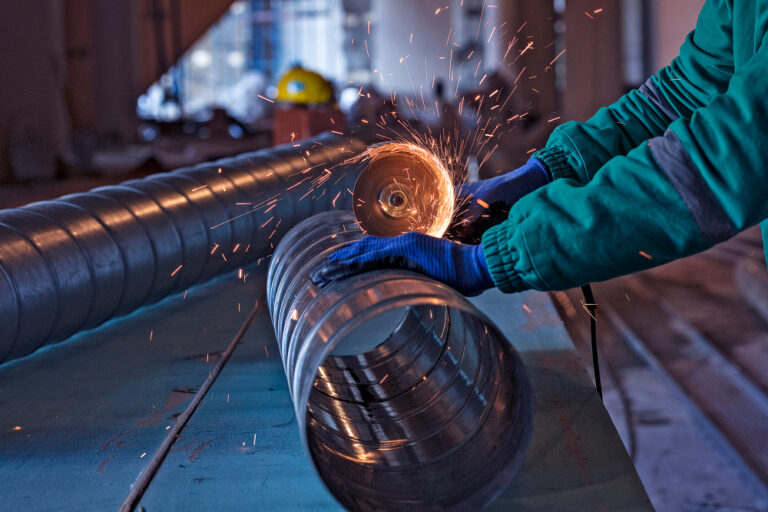
  • Welding distortion is one of the most common problems in marine fabrication – controlling it requires proper joint design, correct welding sequence, pre-setting of components, and effective back-step and balanced welding techniques

Quality management and documentation

  • Every operation must be documented: material receipts, cutting records, fit-up inspections, weld records, NDT reports, and dimensional surveys – all filed against the relevant component identity
  • Classification society surveyors do not accept verbal assurances – the documentation package is the evidence of compliance, and it travels with the component throughout its service life
marine steel fabrication

Types of Marine Steel Fabrication Work

Shipbuilding is the most widely understood application, but the range of marine fabrication work a capable structural contractor can support is considerably broader.

Vessel construction and repair

  • Hull sections, frames, and sub-assemblies for new vessel construction
  • Structural repairs and modifications to existing vessels during dry dock periods
  • Deck equipment foundations, machinery seating, and engine room structural framing
  • Wheelhouse, accommodation block, and superstructure framing fabrication

Offshore and port infrastructure

  • Jetty, berth, and quay structural steelwork
  • Mooring dolphin and breasting dolphin fabrication
  • Gangway structures, accommodation ladder frames, and shore connection bridges
  • Offshore platform structural components, equipment skid frames, and module support structures

Marine facility construction

  • Dry dock gate and caisson structures
  • Covered fabrication halls and boat sheds for shipyard facilities
  • Slipway structures and vessel launching cradles
  • Marine workshop, maintenance facility, and support building construction

Inland waterway and fishing sector

  • Structural components for mechanised fishing vessels and country craft
  • River ferry hull sections and pontoon structures
  • Boat landing jetties, floating pontoons, and waterway infrastructure

8 Things to Look for in a Marine Fabrication Partner

Use this framework to evaluate any marine fabrication contractor before committing scope, cost, and schedule to them.

1. Classification Society Approval or Survey Experience

  • Ask whether the fabricator has experience working under classification society survey – IRS, Lloyd’s Register, Bureau Veritas, or DNV GL
  • Have their welding procedures been formally approved by a classification society for marine material grades and joint configurations?
  • A fabricator encountering class survey for the first time will struggle with witness point scheduling, documentation requirements, and surveyor communications – adding weeks and cost to your project
  • For projects requiring formal class approval, verification of existing approved procedures should be the first qualification check

2. Qualified Welding Procedures and Certified Welders

  • Request copies of the Welding Procedure Specifications (WPS) and Procedure Qualification Records (PQR) relevant to your project’s material grades and joint types
  • All welders must hold current, valid Welder Qualification Test (WQT) certificates currency is maintained through continuity of use; a lapse in production means re-qualification
  • Ask how many certified welders are on the current workforce and what their qualification scopes cover position, material grade, and joint configuration all matter
  • The WPS and welder certificates should be available for review before any fabrication commitment is made

3. In-House NDT Capability

  • NDT should be available either in-house with qualified personnel, or through a named and approved specialist NDT subcontractor with a track record in marine work
  • In-house NDT reduces scheduling dependency, turnaround time, and cost compared with outsourcing every inspection to an external provider
  • Ask for the qualifications of the NDT personnel PCN or ASNT Level II certification is the accepted minimum for most marine applications
  • Confirm which NDT methods are available: RT, UT, MPI, and DPI all have specific applications in marine structural work a fabricator with only one method available may not be able to meet your project ITP requirements

4. Material Traceability Systems

  • Can the fabricator demonstrate full material traceability from the mill certificate, through the cutting list, to the finished marked component?
  • Traceability requires a physical marking scheme (paint marking, stamping, or tagging) that keeps the heat number linked to cut pieces throughout fabrication
  • Without a functioning traceability system, classification society approval of the finished structure is not achievable
  • Ask to see an example of a material traceability record from a previous marine project – a competent fabricator will have this readily available

5. Workshop Capability and Equipment

  • What is the maximum plate thickness and section size the facility can handle cutting, handling, and welding?
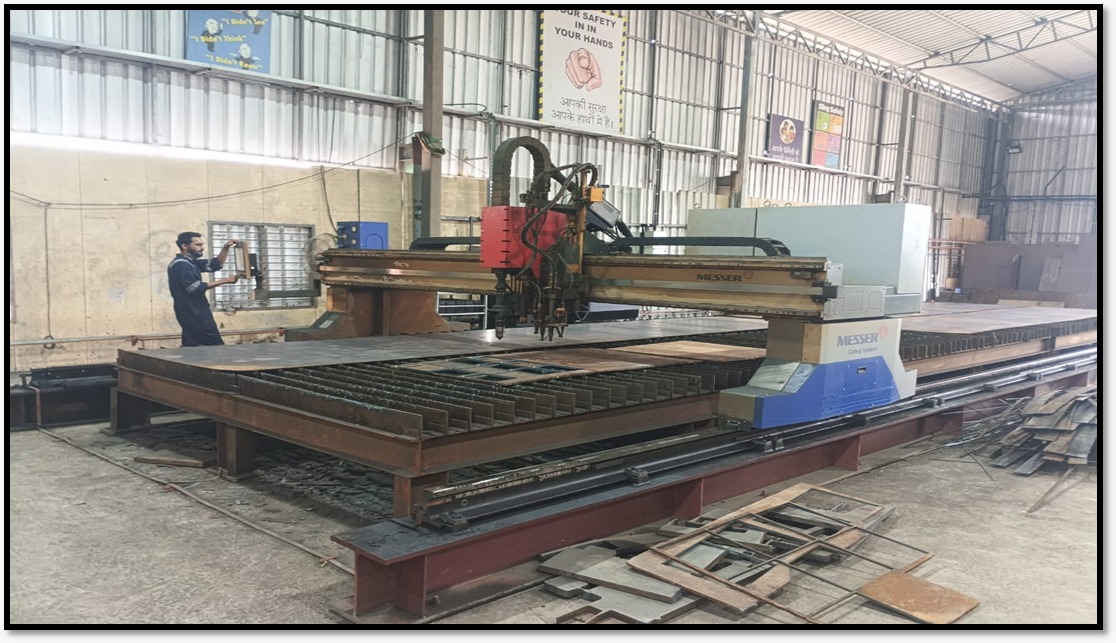
  • What cutting equipment is in use CNC plasma or oxy-fuel cutting for precision profiles, or manual cutting only?
  • What is the workshop’s overhead crane capacity this determines the maximum sub-assembly size that can be fabricated and lifted for transport
  • Is there covered, weather-protected storage for materials and fabricated components exposure of mill-certificated material to weather before use can compromise surface condition and traceability records
  • What is the available workshop floor area and is there a flat, level assembly floor with anchor points for jig fabrication?

6. Dimensional Control and Distortion Management

  • What methods does the fabricator routinely use to control welding distortion pre-setting, back-step welding, balanced welding sequence, thermal straightening?
  • Ask to see examples of dimensional inspection records from previous marine fabrication projects
  • Does the fabricator use welding jigs and fixtures for repeating structural units frames, brackets, and bulkhead stiffeners?
  • Distortion problems identified after fabrication is complete are expensive to correct and often impossible to fully recover ask how they prevent them, not just how they fix them

7. Quality Management System

  • Does the fabricator operate a documented quality management system ISO 9001 certified is the benchmark, but at minimum they should have a defined Inspection and Test Plan (ITP) process for marine work
  • The ITP defines every inspection point in the fabrication sequence, the acceptance criteria, the responsible party, whether a surveyor witness is required, and what records are generated
  • Ask to see the ITP template they propose to use for your project the level of detail in that document tells you a great deal about the maturity of the QMS behind it
  • A fabricator without a documented QMS cannot support classification society survey in a predictable, cost-controlled way

8. Track Record and References

  • How many marine fabrication projects has the contractor completed, of what type, and under which classification society?
  • Can they provide references from previous marine clients – shipyards, port authorities, vessel owners, or offshore operators?
  • What is the largest marine structure or sub-assembly they have fabricated and delivered?
  • Ask specifically about delivery performance against the contracted schedule – marine projects often have hard deadlines tied to dry dock windows or vessel launch dates that cannot be moved
  • Ask whether any of their previous marine work has been subject to class survey rejection or re-work – and how it was resolved
Ship building by Lee builders

The Kerala Advantage for Marine Fabrication

Kerala’s maritime sector is one of the most active in India and Ernakulam district sits at the centre of it. For a marine fabrication partner, geography matters: proximity reduces logistics cost and lead time for heavy structural components, and local knowledge of the sector’s clients and requirements is a genuine operational advantage.

Kerala’s maritime landscape

Organisation / Sector

Relevance to Marine Fabrication

Cochin Shipyard Limited

One of India’s largest public sector shipyards active new-build and ship repair programmes

Cochin Port Authority

Major container and bulk port with ongoing berth, jetty, and infrastructure development

Kerala Inland Navigation Department

Active river ferry and inland waterway vessel construction and maintenance programme

Fishing vessel yards

Construction yards at Beypore, Munambam, Vypeen, and Neendakara active small vessel sector

Coastal and tourism vessels

Growing houseboat, ferry, and coastal cruise vessel sector requiring structural fabrication

Port infrastructure development

Ongoing capital works at Cochin, Beypore, and Vizhinjam ports requiring marine structural steelwork

The geographic advantage for Lee Builders

  • Our fabrication facility in Perumbavoor, Ernakulam district has direct road access to Cochin Shipyard, Cochin Port, and the major inland waterway network reducing logistics cost and transit time for heavy fabricated components
  • Proximity also enables closer coordination during fabrication: client representatives and classification society surveyors can visit the workshop without significant travel overhead
  • Kerala’s skilled workforce has a long tradition of marine trades our team includes welders and fabricators with direct experience in marine application requirements, not just general structural work
  • Established since 1995 – over 29 years of structural steel fabrication in the heart of Kerala’s industrial and maritime corridor

What to Expect from the Marine Fabrication Process

Understanding the stages of a well-managed marine fabrication process helps procurement teams plan their project schedule and know what deliverables to expect at each stage.

Stage 1:  Technical review and pre-fabrication planning

  • Review of design drawings (IFC, DWG, or PDF format), material specifications, and applicable classification society requirements
  • Selection or development of applicable Welding Procedure Specifications (WPS) for the required joint types and material grades
  • Material procurement plan sourcing approved marine-grade steel with mill certificates from an approved stockist
  • Preparation of the Inspection and Test Plan (ITP) for client review and classification society approval before fabrication begins

Stage 2:  Material receipt and traceability

  • Steel received, checked against mill certificates for grade, thickness, and mechanical properties, and heat-number marked on each piece
  • Third-party inspection of material at receipt if required by the classification society or client specification
  • Cutting list prepared and material allocated to specific component identities traceability established at this stage

Stage 3:  Fabrication

  • Profile cutting to precise dimensions using CNC plasma or oxy-fuel equipment; edge preparation for weld joint geometry
  • Assembly and fit-up checked against drawings and within tolerance limits before welding commences a witness hold point in most marine ITPs
  • Welding carried out to the approved WPS by certified, qualified welders
  • In-process dimensional checks and NDT hold points carried out as defined in the ITP not deferred to the end of fabrication

Stage 4:  Inspection, testing, and survey

  • NDT carried out at all specified locations and stages RT, UT, MPI, or DPI as required by the ITP and classification rules
  • Dimensional survey of completed sub-assembly against drawing tolerances
  • Classification society surveyor witness at defined hold points the fabricator coordinates witness point scheduling and documentation
  • Non-conformance reports raised and closed for any defects identified; records retained in the project documentation package

Stage 5:  Surface treatment, documentation, and delivery

  • Surface preparation by abrasive blasting to the specified cleanliness standard (typically Sa 2.5 to ISO 8501-1)
  • Primer coat applied to the specified dry film thickness and inspected before dispatch
  • Final dimensional inspection and component marking for installation
  • Complete documentation package compiled: mill certificates, WPS and PQR records, welder certificates, weld maps, NDT reports, dimensional records, and classification society survey reports
  • Delivery with full documentation package components are not dispatched without the paperwork
Welding in marine steel fabrication

Why Lee Builders for Marine Steel Fabrication

When you appoint Lee Builders for a marine fabrication project, you are working with a team that has been operating structural steel fabrication in Kerala’s industrial and maritime corridor for over 29 years.

What we bringWhat it means for your project
29+ years of structural steel fabrication experienceDepth of production experience across structural, industrial, and marine applications
In-house fabrication workshop, Perumbavoor, KeralaCNC cutting, welding, assembly, and component handling under one roof
Marine application knowledgeUnderstanding of material specifications, weld quality requirements, and survey protocols
Direct access to Kerala’s maritime corridorRoad access to Cochin Shipyard, Cochin Port, and Kerala inland waterway network
Experience with third-party inspection requirementsCapability to support classification society survey and client witness point programmes
Full documentation capabilityMaterial traceability, weld records, NDT coordination, and documentation package delivery
Parallel structural steel construction capabilityMarine fabrication alongside PEB, warehouse, cold storage, and infrastructure projects single supplier for multi-scope programmes
Ship building

Conclusion

Marine fabrication demands a level of technical discipline, documentation rigour, and quality management that separates genuine marine contractors from general steel fabricators. The difference is not always visible in the finished weld it is embedded in the procedures, the certificates, the traceability records, and the survey readiness that allow a classification society to approve the work for marine service.

The eight criteria in this guide give procurement teams a reliable and comprehensive framework for evaluating any marine fabrication partner before scope, cost, and schedule are committed. Apply them consistently, ask for documentation rather than assurances, and you significantly reduce the risk of the rework, delays, and cost overruns that characterise poorly planned marine fabrication procurement.

Kerala’s maritime sector is one of India’s most active and Lee Builders is positioned within it, ready to support new-build fabrication, structural repair, port infrastructure, and marine facility construction across the full scope of what structural steel fabrication can deliver.

How to Maintain a Steel Building

Introduction

A well-maintained steel building can last 50 years. A neglected one can develop serious problems in five. That gap between a structure that performs reliably for decades and one that starts leaking, corroding, and degrading within a few monsoon seasons comes down almost entirely to maintenance.
Most steel building owners receive little practical guidance after handover. The contractor finishes, hands over the keys, and moves on to the next project. This guide is designed to fill that gap.
Steel buildings are genuinely low-maintenance compared to conventional RCC structures no concrete spalling, no rebar corrosion, no plaster cracking. But low maintenance does not mean zero maintenance. The right inspection routine, carried out at the right time of year, catches 90 percent of problems before they become expensive repairs.
Lee Builders has been building and maintaining steel structures across India since 1995. This guide distils what our team has learned from decades of post-handover support written specifically for Indian conditions, and for Kerala’s climate in particular

Table of Contents

Why Steel Building Maintenance Matters

The good news

• Steel is inherently more durable than RCC in several key respects: no concrete spalling, no hidden rebar corrosion, no plaster cracking or waterproofing failure in the slab above you
• Factory-applied protective coatings are engineered to last 10 to 15 years with basic care
• Most routine maintenance tasks require no specialist equipment, no trades, and no significant expenditure

The cost of neglect

The risk with steel buildings is not sudden catastrophic failure it is gradual, progressive deterioration that is expensive to reverse once it has taken hold:
• Corrosion at unprotected edges or fastener points progresses quickly once it starts, especially in Kerala’s humid climate
• Blocked gutters cause water to back up under cladding leading to interior leaks, wet insulation, and internal surface corrosion
• Loose fasteners and minor cladding damage left unattended worsen with every monsoon season
• A small roof repair that costs a few thousand rupees today becomes a cladding replacement that costs several lakhs if left for three monsoons

The Annual Inspection Checklist

This checklist covers every part of a typical steel building. Work through it systematically ideally with a camera to photograph anything that needs attention. The best times to inspect in Kerala and South India are pre-monsoon (April to May) and post-monsoon (November).

Roof System

  • Check all roof cladding panels for dents, punctures, or panel distortion
  • Inspect ridge caps and flashings for lifted edges, cracked sealant, or open joints
  • Check all roof fasteners look for missing, loose, or corroded screws and washers
  • Clear all debris (leaves, branches, silt) from the roof surface
  • Inspect all gutters and downpipes clear blockages, check for sagging or joint separation
  • Check all roof penetrations (vents, pipes, conduits, lightning conductors) for sealant integrity
  • Inspect valley gutters between roof slopes for debris accumulation and sealant condition

Wall Cladding

  • Inspect all wall panels for dents, scratches, or visible paint chalking
  • Check the bottom of wall panels for signs of water ingress, soil contact, or corrosion at the panel base
  • Inspect all wall fasteners for corrosion, looseness, or missing washers
  • Check flashings at the wall-to-floor junction and around all door and window frames
  • Inspect any translucent roof or wall sheeting for yellowing, crazing, or seal failure
  • Check expansion joints and trim flashings for sealant condition

Structural Steel

  • Visually inspect all primary columns at base plate level — look for rust staining, coating breakdown, or water pooling around bases
  • Check all visible bolted connections — look for corrosion on bolt heads, nuts, and washers
  • Inspect purlins and girts for any visible deflection, distortion, or section loss
  • Check all bracing rods and turnbuckle connections — ensure they are tight and undamaged
  • Inspect any crane beams, runway rails, and end stops for condition and alignment
  • Check mezzanine floor connections, beam-to-column joints, and handrail fixings

Doors, Windows and Openings

  • Check all roller shutters and sliding doors for smooth operation, alignment, and seal integrity
  • Inspect door seals and weather strips — replace if cracked, compressed, or missing
  • Check window glazing and frames for sealant failure, condensation between panes, or water ingress marks
  • Lubricate all door tracks, hinges, rollers, and shutter springs
  • Inspect louvre and ridge vent panels for free operation and screen integrity

Drainage and Site Perimeter

  • Check ground slope around building perimeter — water must drain away from the structure, not pool at column bases
  • Clear any vegetation growing against wall cladding, in gutters, or around column bases
  • Inspect any internal floor drains, sump pits, and drainage channels for blockage
  • Check that external hardstanding does not create a dam against the wall base
  • Inspect any retaining walls or earth bunds adjacent to the building for stability
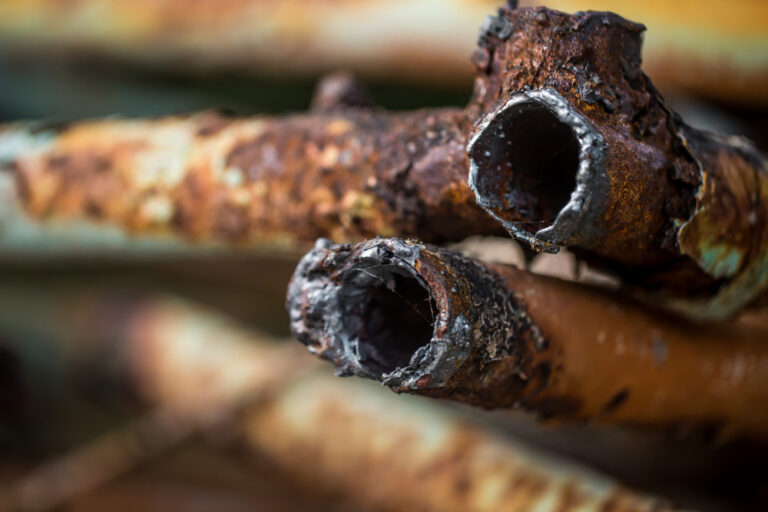
Steel corrosion

Understanding Steel Corrosion in Indian Conditions

Most steel building owners know that rust is the enemy but few know exactly where to look for it, or why it starts where it does. Understanding the mechanism helps you inspect more effectively and catch problems earlier.

Where corrosion is most likely to start

  • Cut edges: wherever steel has been cut during fabrication, the raw metal edge is unprotected unless properly treated; these are typically the first places paint begins to break down
  • Fastener points: around self-drilling screws, where the coating has been punctured during installation; water infiltrates and sits under the washer, initiating corrosion that is invisible from above
  • Column base plates: where the steel column meets the concrete plinth; moisture can accumulate in this joint, particularly if ground drainage around the building is poor
  • Gutter interiors: if gutters are not cleaned regularly, wet debris creates a continuously damp environment against the steel surface — accelerating coating breakdown
  • Cladding panel overlaps: where two panels overlap, capillary action can draw water into the joint if the sealant has failed or was never adequately applied
  • Internal condensation points: in uninsulated warehouses, condensation forms on the internal surface of cold steel during humid weather, creating a wet surface that cannot dry naturally

The Kerala and coastal context

Kerala’s climate is among the most aggressive in India for steel coating systems. High ambient humidity, an average annual rainfall of 2,800 to 3,200mm in the Ernakulam and Perumbavoor area, and salt-laden air in coastal districts all accelerate coating degradation beyond what inland or arid-region standards anticipate.

Buildings within 5km of the coast require more frequent inspection intervals and earlier recoating than inland structures. Chloride-induced corrosion — driven by salt in the atmosphere — is chemically more aggressive than standard atmospheric corrosion and requires specific coating systems that include a barrier primer to resist chloride penetration.

Protective Coatings - When to Recoat and What to Use

The protective coating system is the primary defence against corrosion on a steel building. Understanding its service life and the signs of degradation helps you plan recoating at the right time before failure, not after.

Typical coating service life in Indian conditions

Coating System

Inland / Low Humidity

Coastal / High Humidity

Standard alkyd primer + topcoat

8 – 12 years

5 – 8 years

Epoxy primer + polyurethane topcoat

12 – 18 years

8 – 12 years

Hot-dip galvanising + paint overcoat

20 – 25 years

15 – 20 years

Pre-painted (Galvalume / Zincalume) cladding

15 – 20 years

10 – 15 years

Signs it is time to recoat

  • Visible chalking or colour fading on the topcoat surface — indicates UV degradation of the binder
  • Topcoat cracking or flaking in localised areas — loss of adhesion to the primer beneath
  • Rust staining visible through the coating — the underlying steel has begun to oxidise
  • Coating thickness below specification when tested with a DFT gauge
  • Widespread loss of gloss across the roof surface — the topcoat is approaching end of service life

The recoating process – an overview

  1. Surface preparation: remove loose and flaking paint; mechanically or chemically treat any rust spots to bare metal; clean entire surface of dust, oil, and contamination
  2. Primer coat: apply a compatible primer to all prepared areas — compatibility with the original factory primer is critical; incompatible systems cause inter-coat adhesion failure
  3. Finish coat: apply topcoat in the specified colour and sheen levelm
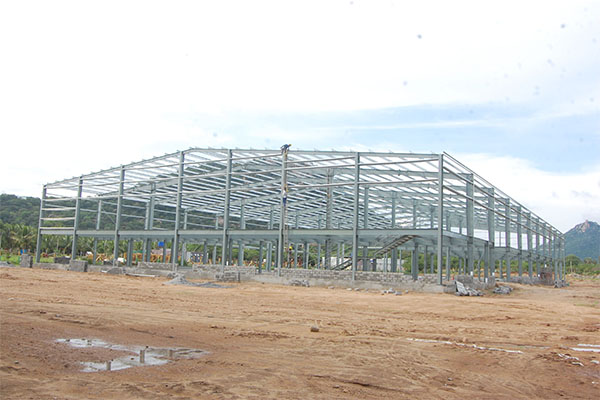
miantaining a peb structure on monsoon

Monsoon Preparation - What to Do Before the Rains

In Kerala, the annual maintenance calendar is shaped by the monsoon. The southwest monsoon arrives in early June and runs through September. The northeast monsoon follows in October and November. Together, they deliver over 3,000mm of rainfall in many parts of the state.
A blocked gutter or failed roof sealant that is manageable in the dry season becomes a serious interior flood risk within days of the first heavy monsoon rainfall. Pre-monsoon preparation is the single most important maintenance activity of the year for any steel building in Kerala.

Pre-monsoon checklist – complete by end of May

  • Clear all gutters and downpipes of debris, leaves, silt, and bird nests — this is the single most critical pre-monsoon task
  • Inspect and reseal all roof flashings, ridge caps, valley gutters, and roof penetrations
  • Check and replace any missing or damaged roof fasteners and their neoprene washers
  • Inspect wall-to-roof junction flashings and reseal any open joints
  • Clear all vegetation from the building perimeter and from gutters
  • Ensure all drainage channels, sumps, and stormwater outlets around the building are clear and free-flowing
  • Test all roller shutters and sliding doors — monsoon humidity can cause aluminium tracks to swell and steel tracks to corrode if not kept clean and lubricated
  • Check mezzanine floor drains and internal drainage channels if applicable

During the monsoon

  • Walk the building interior after the first heavy rainfall of the season and identify any new leak points immediately
  • Photograph the location of any leaks for your maintenance record — note the roof area and the internal drip point
  • Do not attempt to reseal a wet roof surface — silicone and polyurethane sealants require a dry surface to bond properly; wait for a dry spell and address the repair promptly within the same monsoon season
  • Clear gutters of debris accumulation after any major storm event if safe to do so

Post-monsoon – November

  • Conduct the full annual inspection from the Section 2 checklist
  • Address all leak repairs identified during the monsoon season
  • Clear all post-monsoon debris accumulation from gutters, roof, and building perimeter
  • Check for any cladding distortion or fastener damage caused by storm debris or high winds

Maintenance Notes by Building Type

Different building types have specific maintenance requirements beyond the standard annual checklist. Here are the most important additional considerations by structure type.
WAREHOUSE / INDUSTRIAL
  • Forklift and vehicle impact damage to wall cladding at low level is common install bolt-on steel protection rails at all vehicle-accessible wall areas to prevent cladding damage
  • Overhead crane systems: check crane rail welds and runway beam connections annually; lubricate end carriage wheels and rail clamps; check for rail misalignment that causes side loading on runway beams
  • Check mezzanine floor connections, beam-to-column joints, and handrail fixings at every annual inspection
  • Internal condensation on the underside of uninsulated roof cladding during Kerala’s humid season creates a dripping ceiling effect consider installing glasswool or foil insulation if condensation is a recurring issue
COLD STORAGE FACILITY
  • Cold room door seals are the highest-maintenance item in a cold storage building inspect every three months; a failed door seal increases refrigeration energy consumption by 20 to 40 percent and causes ice build-up on the door frame
  • Inspect insulated panel joints for sealant integrity at every annual inspection any break in the vapour seal allows warm moist air to infiltrate the insulation core, causing irreversible degradation
  • Condensation drainage channels and drain points in the refrigerated zone must be kept clear at all times to prevent ice blockage and floor heave
  • Check the condition of the vapour barrier at the floor-to-wall junction annually damage here is difficult and expensive to repair once the refrigeration system is in service
MULTISTOREY STEEL BUILDING
  • Fire protection coatings (intumescent paint) on structural steel members require periodic inspection check annually for cracking, delamination, physical impact damage, or areas of missing coverage; any defects must be made good promptly
  • Inspect all floor beam-to-column connections, floor deck welding, and composite slab condition at every annual inspection
  • External cladding and curtain wall systems require sealant and gasket inspection twice yearly failed gaskets allow water infiltration that is difficult to trace once it has migrated internally
  • Check all external facade fixings and bracket connections for corrosion annually
RAILWAY AND INFRASTRUCTURE STRUCTURES
  • Railway structures typically operate under specific maintenance schedules defined by the asset owner refer to the relevant Indian Railways maintenance manual for the structure classification
  • Third-party structural inspections are typically required at defined intervals for structures in railway operational areas retain inspection reports and any remedial work completion certificates
  • Platform canopy structures require particular attention to column bases, which are often in a high-moisture environment from track drainage
  • Overhead equipment (OHE) clearance zones must be maintained when carrying out maintenance works on railway structures ensure all clearance permits are obtained before any elevated work

Conclusion

Steel buildings maintained well are among the most durable commercial and industrial structures available in India today. A structure built to IS 800 standards and maintained according to the programme in this guide will perform reliably for 40 to 50 years – and in many cases well beyond that.

The maintenance requirement is genuinely low. Two inspections per year, a thorough pre-monsoon preparation, periodic fastener replacement and sealant touch-ups, and a full recoating every 10 to 15 years – that is the entire programme for a typical warehouse or industrial building.

The buildings that fail early are almost always the ones where minor problems were noticed and left for the next monsoon. The buildings that last 50 years are the ones where owners treat maintenance as a routine annual commitment, not an emergency response.