





Logistics is evolving faster than ever. E-commerce growth, next-day delivery expectations, and increasingly automated supply chains have transformed how goods move from manufacturer to customer. In this environment, warehouse infrastructure is no longer a background asset — it is a competitive differentiator. This is exactly why logistics companies prefer PEB warehouses over conventional construction: they deliver the speed, flexibility, and operational efficiency that modern supply chains demand. From faster project timelines to column-free storage that supports automation, PEB warehouses have become the default choice for forward-looking logistics operators across India.
Table of Contents
What is a PEB Warehouse?
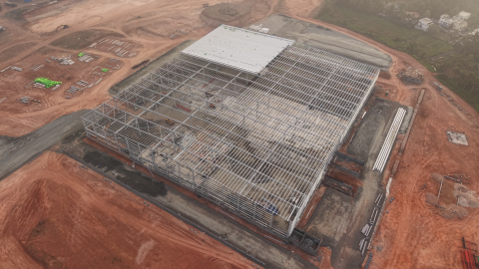
A Pre-Engineered Building (PEB) is a steel structure designed and fabricated in a factory, then transported to the site for assembly. Unlike conventional construction, where columns, beams, and roofing are built brick-by-brick on location, PEB components arrive pre-cut, pre-drilled, and ready to bolt together.
This factory-first approach means tighter tolerances, less on-site labour, and far fewer weather-related delays. PEB systems are widely used for logistics parks, distribution centres, cold storage units, industrial sheds, and large-span warehouses where speed and floor space matter more than architectural ornamentation.
Industries That Benefit from PEB Warehouses
- E-commerce fulfilment and last-mile hubs
- Third-party logistics (3PL) providers
- FMCG distribution and storage
- Manufacturing and component warehousing
- Cold storage and temperature-controlled logistics
- Retail distribution centres
- Pharmaceutical storage and distribution
Why Logistics Companies Choose PEB Warehouses
Faster Construction and Earlier Operations
Because primary framing, purlins, and roof sheets are fabricated off-site in parallel with civil foundation work, PEB warehouses typically move from design to handover in a fraction of the time conventional construction requires. For a logistics company, every month saved on construction is a month of earlier revenue generation and faster market entry.
Large Column-Free Storage Space
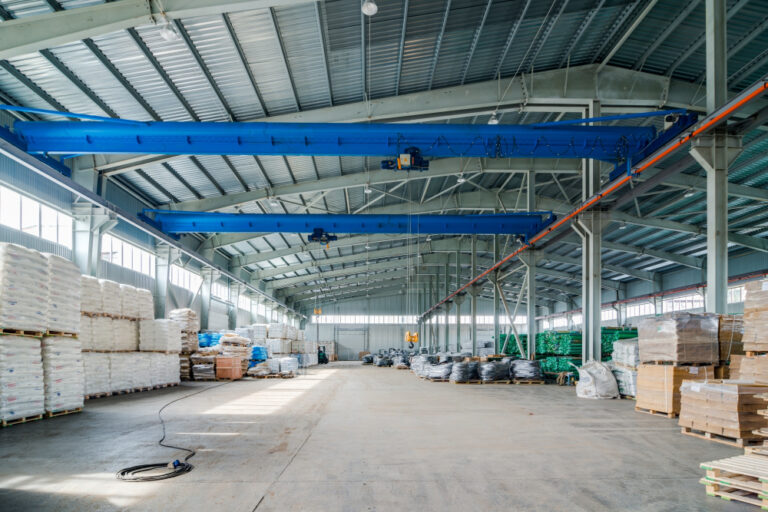
Clear-span PEB designs eliminate interior columns across wide bays. This translates directly into more usable floor area, unobstructed forklift and reach-truck movement, and the flexibility to install tall pallet racking or automated storage systems without structural interference.
Lower Construction and Maintenance Costs
Reduced on-site labour, minimal material wastage, and standardised components bring down upfront construction costs. Factory-applied protective coatings on steel members also reduce long-term maintenance spend compared to plastered brick or RCC structures that need repainting, re-plastering, and periodic repair.
Easy Future Expansion
Logistics demand rarely stays flat. PEB structures are modular by design, so adding bays lengthwise, raising eave height, or attaching a new wing can be done with minimal disruption to ongoing warehouse operations — a major advantage for 3PL providers scaling with client growth.
Durable for Heavy Industrial Use
Modern PEB systems are engineered to local wind, seismic, and load codes, and galvanised or painted steel sections resist corrosion when properly coated. This makes PEB warehouses well suited to coastal, humid, and high-rainfall regions where long-term structural integrity matters.
Better Energy Efficiency
Insulated roofing and wall panels, skylights for natural daylight, and turbo or ridge ventilation systems all reduce dependence on artificial lighting and mechanical cooling. For temperature-sensitive goods or large FMCG warehouses, this translates into measurable energy savings over the building’s life.
Supports Warehouse Automation
Open, obstruction-free layouts are essential for modern logistics technology. PEB warehouses readily accommodate:
- Conveyor systems and sortation lines
- Automated storage and retrieval systems (AS/RS)
- Warehouse robotics and AGVs
- Smart inventory and IoT-based tracking systems
PEB Warehouse vs Conventional Warehouse
Factor | PEB Warehouse | Conventional Warehouse |
Construction Time | 8-12 weeks typical for mid-size facilities | 6-12 months or longer |
Cost | Lower overall cost; less labour and material waste | Higher cost due to labour-intensive processes |
Maintenance | Low; factory-coated steel resists corrosion | Higher; plaster, paint, and RCC need regular upkeep |
Expansion | Simple bay addition, minimal disruption | Requires major structural rework |
Storage Efficiency | Column-free clear spans maximize usable area | Columns and beams interrupt floor space |
Durability | Engineered for wind, seismic, and heavy loads | Depends on quality of masonry and construction |
Sustainability | Recyclable steel, energy-efficient insulated panels | Higher material consumption, less recyclable |
Is a PEB Warehouse the Right Choice?
A PEB warehouse is generally the right choice when a business is:
- Expanding rapidly and needs storage capacity online quickly
- Working within a defined budget and looking to control costs
- Planning large, column-free storage or distribution space
- Building a regional distribution centre with future expansion in mind
- Running heavy industrial operations that need a durable, low-maintenance structure
For logistics companies balancing speed-to-market with long-term operational costs, PEB construction consistently checks all these boxes.
Conclusion
The reasons logistics companies prefer PEB warehouses come down to measurable business outcomes: faster delivery of usable space, lower construction and maintenance costs, easy scalability, and layouts built for automation. As supply chains continue to modernise, PEB construction gives logistics operators the operational efficiency and long-term value that conventional building methods struggle to match.
Planning a logistics or industrial warehouse project? Get in touch with Lee Builders for custom PEB warehouse solutions engineered for your operational needs, budget, and timeline.
FAQ
How long does it take to construct a PEB warehouse?
Most mid-size PEB warehouses can be constructed in 8-12 weeks from foundation completion, compared to 6 months or more for conventional construction, depending on size and site conditions.
Are PEB warehouses suitable for cold storage?
Yes. With insulated panels and vapour barriers, PEB structures are commonly used for cold storage and temperature-controlled logistics facilities.
Can a PEB warehouse be expanded later?
Yes. PEB systems are modular, so additional bays or wings can typically be added with minimal disruption to existing operations.
Is a PEB warehouse more cost-effective than a conventional warehouse?
In most cases, yes. Lower labour requirements, reduced material wastage, and faster build times bring down both upfront and long-term costs compared to conventional brick-and-RCC construction.
What industries use PEB warehouses most?
E-commerce, 3PL, FMCG, cold storage, retail distribution, manufacturing, and pharmaceutical companies are the most common users of PEB warehouses.