





Introduction
You have a warehouse to build. You have a site, a brief, and a budget. And you have a decision in front of you that will affect your construction cost, your timeline, your operational efficiency, and your maintenance bills for the next 30 to 40 years: steel or concrete?
Both materials have been used to build warehouses successfully across India. Both can deliver a structurally sound, functional building. But for most industrial and logistics applications today, one option pulls significantly ahead in cost, speed, flexibility, and long-term value.
This guide from the team at Lee Builders steel construction specialists based in Perumbavoor, Kerala, with over 29 years of experience gives you an honest, objective comparison of both approaches. By the end, you will have a clear framework for making the right decision for your specific project.
What this guide covers
Understanding the Two Construction Methods
Before comparing them, it helps to understand exactly what each approach involves because the differences start at the very first stage of construction.
Steel Warehouse Construction (PEB / Structural Steel)
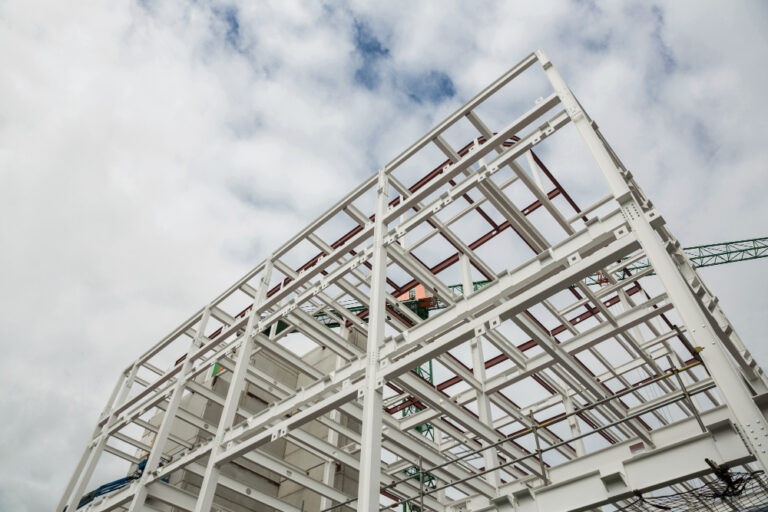
- Primary structure: hot-rolled steel frames (columns and rafters) designed and fabricated off-site
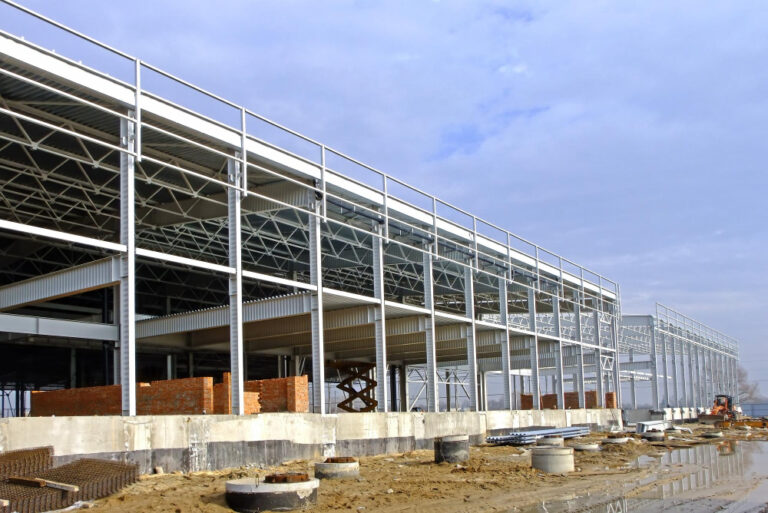
- Assembly method: bolted connections on-site minimal wet work, no formwork required
- Building envelope: colour-coated or insulated metal cladding panels for roof and walls
- Foundation: typically isolated pad footings or a combined footing lighter and shallower than RCC equivalents
- Timeline advantage: fabrication runs in parallel with site preparation
Concrete Warehouse Construction (RCC)
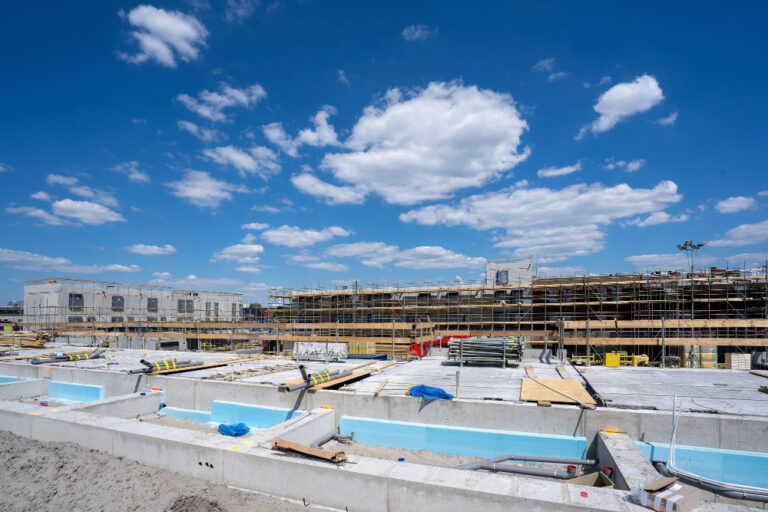
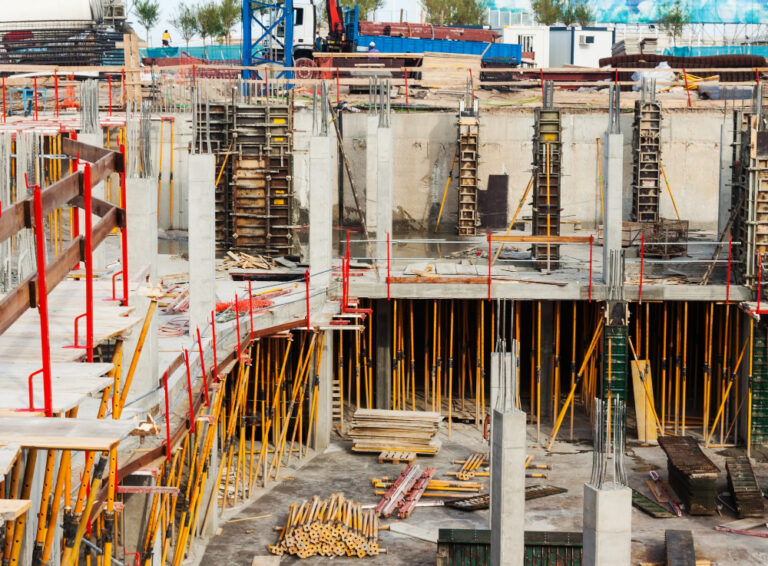
- Primary structure: reinforced cement concrete columns, beams, and slabs cast in-situ or using precast panels
- Assembly method: formwork, pouring, curing sequential process that cannot run in parallel
- Building envelope: block or brick masonry walls with plaster finish; concrete or metal roof
- Foundation: heavier structure requires deeper pad footings, raft foundations, or pile foundations depending on soil conditions
- Timeline: each structural phase must cure before the next begins
It is also worth noting that hybrid structures exist for example, a steel roof over concrete columns, or a steel superstructure on a concrete podium. These are used in specific situations but are outside the scope of this comparison, which focuses on the two dominant approaches for warehouse construction.
Cost Comparison
Cost is the number-one question for any warehouse project. The honest answer is that steel and concrete need to be compared across three distinct cost layers not just the headline construction cost.
Layer 1: Construction Cost per Square Foot
Specification | Steel Warehouse | Concrete Warehouse |
Basic industrial (standard span) | Rs. 1,500 – Rs. 2,000 / sq. ft. | Rs. 1,800 – Rs. 2,400 / sq. ft. |
Mid-range commercial / logistics | Rs. 2,000 – Rs. 2,800 / sq. ft. | Rs. 2,400 – Rs. 3,200 / sq. ft. |
High-spec / insulated | Rs. 2,800 – Rs. 3,500 / sq. ft. | Rs. 3,000 – Rs. 4,000+ / sq. ft. |
At the construction stage, steel is typically 15 to 25 percent cheaper than an equivalent RCC structure. The reasons are straightforward: less on-site labour, minimal formwork, and factory-optimised steel sections that use only the material required by the engineering model.
Layer 2: Foundation Cost
Steel structures are significantly lighter than their concrete equivalents. A typical PEB warehouse exerts far lower column loads on the ground, which translates directly into smaller, shallower foundations. In good soil conditions this saves money; in poor or waterlogged soil common in parts of Kerala, it can make a substantial difference to the overall project budget.
RCC structures, by contrast, are heavy. They demand larger pad footings, raft foundations, or in weak soil conditions, a piled foundation system. These costs add up quickly, particularly for large-footprint warehouses.
Layer 3: Lifecycle Cost (Maintenance and Repair)
This is where the long-term picture comes into focus. Over a 30-year ownership period:
- Steel cladding: periodic recoating every 10 to 15 years; structural steel itself is virtually maintenance-free if properly detailed and coated at installation
- RCC structures: concrete carbonation, rebar corrosion, and spalling are common in India’s humid climate particularly in coastal Kerala; plaster cracks, seepage, and waterproofing failures require ongoing attention and expenditure
When all three cost layers are added together across the full ownership period, steel consistently delivers a lower total cost of ownership for warehouse applications in India.
Construction Timeline
For a business waiting to begin operations, every week of construction delay has a real cost, lease payments on a site that isn’t generating revenue, delayed product launches, or missed seasonal demand windows. The timeline comparison between steel and concrete warehouses is one of the starkest differences between the two approaches.
Phase | Steel Warehouse | Concrete Warehouse |
Design and engineering | 2 – 3 weeks | 3 – 6 weeks |
Foundation works | 2 – 4 weeks | 3 – 6 weeks |
Structural erection | 3 – 6 weeks | 12 – 24 weeks |
Cladding and finishing | 2 – 3 weeks | 4 – 8 weeks |
Typical total duration | 10 – 16 weeks | 22 – 44 weeks |
The decisive factor is that steel fabrication runs in parallel with site preparation and foundation work. While the foundation is being cast and cured, the steel components are being cut, drilled, and painted in the factory. The moment the foundation is ready, erection can begin immediately.
With RCC construction, each phase is sequential. The columns must be poured and cured before the beams can be cast. The beams must be complete before the slab can be poured. Each stage adds weeks of elapsed time regardless of how many workers are on-site.

Structural Performance and Durability
The most common concern clients raise when considering steel warehouses is a straightforward one: is steel actually as strong as concrete? The answer backed by decades of engineering data and thousands of completed structures across India is yes, and in several key respects, stronger.
Strength and Load-Bearing Capacity
Modern structural steel has a far higher strength-to-weight ratio than reinforced concrete. A steel frame can carry equivalent loads using a fraction of the material mass. PEB frames are engineered to IS 800 (Code of Practice for General Construction in Steel) and IS 875 (Code of Practice for Design Loads) the same regulatory framework that governs RCC design in India.
Steel warehouses routinely handle heavy uniformly distributed floor loads, overhead crane systems, mezzanine floors, and roof-mounted equipment all without any structural compromise.
Wind and Seismic Performance
Steel has a structural property that RCC lacks: ductility. In an extreme wind event or seismic load, a steel frame deforms before it fails absorbing energy and giving time for occupants to evacuate. RCC, by contrast, is brittle under extreme loads unless very carefully designed and detailed with additional reinforcement.
Kerala falls within Wind Zone III under IS 875. Lee Builders designs every structure to be fully compliant with the applicable wind zone and seismic zone requirements for the project location.
Durability in Indian Conditions
Both steel and concrete warehouses can achieve service lives of 40 to 50 years or more when properly designed and maintained. The vulnerabilities are different:
- Steel’s primary vulnerability: corrosion effectively managed through hot-dip galvanising of connections, factory-applied protective coatings, and good architectural detailing that prevents water ponding or trapping
- RCC’s primary vulnerabilities: concrete carbonation and chloride ingress leading to rebar corrosion, spalling, and structural degradation particularly aggressive in Kerala’s coastal, high-humidity environment
Design Flexibility and Scalability
Clear Span – Unobstructed Floor Space
This is perhaps the single most important structural difference for warehouse operators. A steel PEB frame can achieve clear spans of 60, 70, 80, or even 90 metres and beyond with no internal columns whatsoever. The entire floor area is available for racking, forklift movement, production lines, or bulk storage.
An RCC structure, by contrast, requires columns at intervals of 6 to 9 metres depending on the slab design. In a 60-metre wide warehouse, that means a grid of internal columns that disrupts racking layouts, limits vehicle turning circles, and reduces usable storage volume. For logistics and warehousing operations, this is a significant operational disadvantage.
Building Height
Modern logistics warehouses require clear internal heights of 10 to 18 metres to accommodate high-bay racking systems. Achieving these heights in RCC is expensive formwork costs, concrete volumes, and the engineering complexity of tall slender columns all add cost. Steel achieves tall eave heights naturally and economically, with no additional structural complexity.
Future Expansion
This is where the long-term business case for steel becomes undeniable. A PEB warehouse can be extended along its length by adding bays simply bolting new frames onto the existing end frame. The building can be widened, raised in height, or fitted with additional mezzanine levels. Crane systems can be added to existing frames if specified at the design stage.
Expanding an RCC warehouse typically requires demolition of structural walls or columns, redesign of the foundation system, and significant disruption to ongoing operations. In most cases it is more economical to build a new structure than to expand an existing RCC one.
Sustainability and Environmental Impact
Sustainability is an increasingly important consideration for businesses with ESG reporting requirements, green building certifications, or simply a commitment to responsible construction practices.
Steel
- 100% recyclable at end of life, steel retains full material value when the building is eventually demolished or reconfigured
- Factory fabrication generates minimal on-site waste, components are cut to precise dimensions in the factory
- Lighter structure requires less concrete and excavation for foundations lower embodied carbon in the substructure
- Insulation systems (glasswool, rockwool, polyurethane sandwich panels) deliver high thermal performance, reducing operational energy consumption
- Can contribute to GRIHA and LEED green building credits
Concrete
- Cement production is among the highest sources of embodied carbon in the construction industry globally
- Demolition waste is largely non-recyclable and ends up in landfill
- Heavier structure demands more material in foundations higher total embodied carbon
For businesses that need to report on their construction footprint or are targeting green building certification, steel is the significantly more sustainable option.
When Concrete Is Still the Right Choice
Lee Builders is a steel construction specialist but we also believe in giving clients an honest assessment. There are specific situations where conventional RCC construction remains the more appropriate choice:
- Multi-storey residential construction: RCC remains the standard for apartment buildings, housing, and mixed-use residential structures where the floor plate, partition layout, and acoustic requirements suit cast-in-situ or precast concrete
- Structures requiring masonry facades: where local planning requirements or architectural briefs specify a stone, brick, or masonry appearance that is difficult to achieve with metal cladding
- Very small structures: for buildings under 200 square metres, the economics of a full PEB system with its engineering, fabrication, and logistics overhead do not scale down efficiently
- Extremely remote locations: where steel transport is impractical due to poor road access but local aggregate and labour are readily available
- Very heavy floor loading throughout: for industrial processes involving extremely heavy machinery, presses, or forging equipment that benefit from thick RCC slabs across the entire floor plate
If your project falls into one of these categories, Lee Builders will tell you, and refer you to the right solution. Our goal is to recommend the best outcome for your project, not simply to sell steel.
The Verdict - Which Should You Choose?
Here is the decision framework in plain terms:
Choose Steel if… | Choose Concrete if… |
✅ Your project is a warehouse, factory, logistics hub, or cold storage | ✅ The project is residential or mixed-use with significant living spaces |
✅ Speed of construction is a priority | ✅ Local planning requires a masonry or stone facade appearance |
✅ You want maximum unobstructed floor space for racking or operations | ✅ The structure requires extremely heavy RCC floor slabs throughout |
✅ You may need to expand or reconfigure the building in the future | ✅ The site is remote with very limited steel transport access |
✅ Long-term cost efficiency and sustainability matter to your business | |
✅ You are building in a coastal or high-humidity environment like Kerala |
For the overwhelming majority of warehouse, industrial, logistics, and commercial building projects in India, steel is the better choice. It is faster, more economical, more flexible, and more sustainable. The technology is mature, the engineering codes are well-established, and the track record speaks for itself.
Why Lee Builders for Your Steel Warehouse Project?
When you commission a warehouse from Lee Builders, you get a single point of accountability across every phase from structural design through factory fabrication to on-site erection and handover.
| What we bring | What it means for your project |
| 29+ years of steel construction experience | Proven expertise across every scale of warehouse project |
| End-to-end delivery under one roof | Design, fabrication, erection no coordination gaps between contractors |
| In-house metal fabrication capability | Full quality control at every stage of production |
| Diverse project portfolio | Warehouses, cold storage, multistorey buildings, railway infrastructure |
| Government and institutional track record | Completed projects for Southern Railways |
| Kerala-based, pan-India project capability | Local knowledge, national reach, competitive logistics |
| Transparent, itemised pricing | No hidden costs you know exactly what you are paying for |
Conclusion
For warehouse construction in India, steel wins on cost, speed, flexibility, and sustainability in the vast majority of scenarios. It delivers lower construction costs, a lighter foundation requirement, a faster build programme, column-free floor space, easy future expansion, and significantly lower lifecycle maintenance expenditure.
Concrete has its place primarily in residential construction and specific situations where RCC is clearly the right engineering or planning choice. But for industrial, logistics, and commercial warehouse projects, the case for steel is overwhelming.
Lee Builders has been building steel structures across India since 1995. Our team has the experience, the in-house capability, and the track record to deliver your warehouse project on time, on budget, and built to last.